Vacuum Circuit Breaker Working Principle, Types & Uses
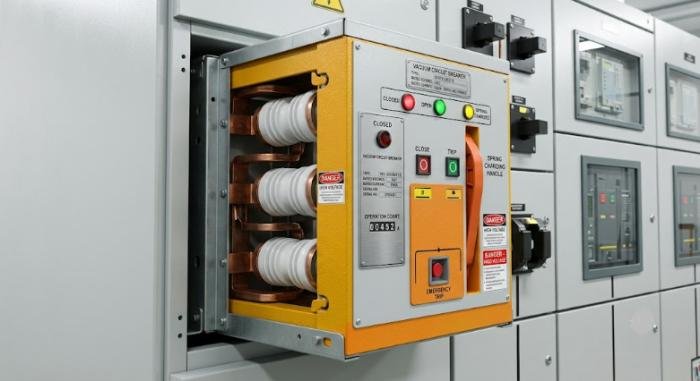
Modern electrical systems face constant risks from short circuits, overloads, and unexpected faults that can damage expensive equipment, interrupt operations, and create serious safety hazards. Traditional protection methods may require frequent maintenance or lack the reliability needed for today’s demanding industrial and commercial environments.
Vacuum circuit breaker stands out as an efficient and dependable solution. By using vacuum technology to extinguish electrical arcs quickly and safely, it provides superior protection, longer service life, and lower maintenance costs compared to many conventional circuit breakers.
Vacuum circuit breaker, including its working principle, key components, types, practical uses, advantages, maintenance tips, and selection factors, helping you make informed decisions for safer and more reliable power distribution systems.
Read More: Online jude.com Review: Features, Safety, Pros, Cons & Tips
What Is a Vacuum Circuit Breaker?
Vacuum circuit breaker is an electrical switching device designed to protect power systems from overloads, short circuits, and other electrical faults. It interrupts the flow of current by separating electrical contacts inside a sealed vacuum chamber known as a vacuum interrupter.
When a fault occurs, an electric arc forms between the contacts as they separate. Because the chamber contains almost no gas molecules, the arc cannot sustain itself and extinguishes rapidly.
This quick interruption minimizes equipment damage and restores insulation strength almost immediately. Medium-voltage systems, typically ranging from 3.3 kV to 36 kV, although some specialized models are available for higher voltages.
Why Is It Called a Vacuum Circuit Breaker?
The name comes from the vacuum environment inside the interrupter. Unlike oil or SF₆ gas breakers, no external medium is required to extinguish the arc. The vacuum acts as an excellent insulator while allowing extremely fast arc extinction.
This design offers several important benefits:
- High interrupting capability
- Longer equipment lifespan
- Minimal maintenance requirements
- Reduced environmental impact
- Improved operational safety
Main Components of a Vacuum Circuit Breaker
Understanding the construction of a breaker helps explain why it performs so efficiently. Although manufacturers may use different designs, the essential components remain similar.
Vacuum Interrupter
The vacuum interrupter is the heart of the breaker. It consists of a sealed chamber that contains fixed and moving electrical contacts under high vacuum conditions. Its primary functions are:
- Interrupt electrical current
- Extinguish the arc
- Restore insulation after current interruption
Fixed Contact
The fixed contact remains stationary and provides one side of the electrical connection. It is made from high-quality conductive materials that resist wear and heat generated during switching operations.
Moving Contact
The moving contact opens and closes the electrical circuit. During normal operation, it stays connected to the fixed contact. When a fault is detected, the operating mechanism quickly pulls it away, creating an arc that is extinguished inside the vacuum interrupter.
Operating Mechanism
The operating mechanism controls the opening and closing actions of the breaker. Modern systems generally use:
- Spring-operated mechanisms
- Motor-charged spring mechanisms
- Electromagnetic actuators
Insulating Housing
The interrupter is enclosed within an insulating housing made from porcelain or epoxy resin. This housing provides electrical insulation while protecting internal components from moisture, dust, and environmental contaminants.
Control Circuit
The control circuit receives signals from protective relays and initiates breaker operation. It monitors system conditions and ensures the breaker trips automatically whenever abnormal current levels are detected.
Working Principle of a Vacuum Circuit Breaker
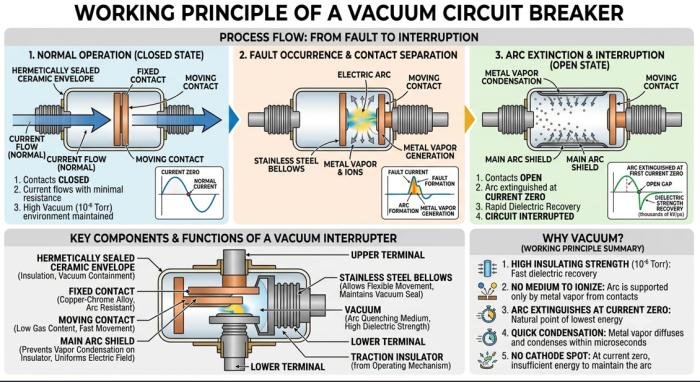
The operating principle is based on rapid arc extinction inside a vacuum. The process occurs in several stages:
Normal Operating Condition: During normal operation, the fixed and moving contacts remain closed, allowing electrical current to flow freely through the circuit.
Fault Detection: When a short circuit or overload occurs, protective relays immediately detect the abnormal current. These relays send a trip signal to the breaker’s operating mechanism.
Contact Separation: The operating mechanism separates the moving contact from the fixed contact within milliseconds.As the contacts separate, an electric arc forms due to the ionized metal vapor released from the contact surfaces.
Arc Extinction: Inside the vacuum chamber, there are very few gas molecules to sustain ionization. As the alternating current naturally reaches zero, the metal vapor rapidly condenses on the contact surfaces, causing the arc to extinguish almost instantly. This quick interruption prevents excessive heating and minimizes damage to connected equipment.
Circuit Isolation: Once the arc disappears, the vacuum immediately regains its high dielectric strength. This prevents the arc from restriking and safely isolates the faulty section of the electrical system.
Practical Example: Imagine an industrial motor developing a short circuit. Within milliseconds, the protection relay detects the fault and commands the breaker to trip. The contacts separate, the arc is extinguished inside the vacuum chamber, and power is disconnected before the fault can damage transformers, cables, or expensive production equipment. This rapid response helps reduce downtime and improves workplace safety.
Professional Comparison Table
| Feature | Vacuum Circuit Breaker | Oil Circuit Breaker | SF₆ Circuit Breaker |
| Arc Quenching Medium | Vacuum | Insulating Oil | SF₆ Gas |
| Maintenance | Very Low | High | Moderate |
| Environmental Impact | Eco-friendly | Oil disposal concerns | Greenhouse gas concerns |
| Fire Risk | Very Low | High | Very Low |
| Service Life | Long | Moderate | Long |
| Switching Speed | Fast | Moderate | Fast |
| Typical Application | Medium Voltage | Older Installations | High Voltage |
Types of Vacuum Circuit Breaker
Different electrical systems require different breaker configurations. Manufacturers design vacuum circuit breakers to suit various installation environments, maintenance requirements, and operating conditions. Understanding these types helps engineers and facility managers select the most suitable option.
1. Indoor Vacuum Circuit Breaker
Indoor models are installed inside electrical switchgear panels or substations where environmental conditions are controlled. They are commonly found in factories, hospitals, commercial buildings, and industrial plants.
Key features:
- Compact design
- Easy maintenance
- High operational reliability
- Protection from dust and weather
2. Outdoor Vacuum Circuit Breaker
Outdoor breakers are designed to withstand harsh weather conditions such as rain, dust, humidity, and extreme temperatures. They are installed in utility substations, power transmission networks, and renewable energy facilities. Their weatherproof construction ensures reliable operation throughout the year with minimal maintenance.
3. Fixed-Type Vacuum Circuit Breaker
A fixed-type breaker is permanently mounted inside switchgear. It is generally used where breaker replacement is infrequent and maintenance schedules are well planned.
Advantages include:
- Lower installation cost
- Strong mechanical stability
- Simple electrical connections
4. Draw-Out Vacuum Circuit Breaker
A draw-out design allows the breaker to be removed from its compartment without dismantling the entire switchgear assembly. This design offers several practical benefits:
- Faster maintenance
- Easy inspection
- Reduced system downtime
- Improved operator safety
Uses and Applications of Vacuum Circuit Breaker
Vacuum circuit breaker is used wherever dependable medium-voltage protection is required. Its fast switching speed and excellent arc-quenching capability make it suitable for a wide range of electrical installations.
Industrial Manufacturing Plants
Manufacturing facilities operate heavy machinery, motors, compressors, and automated production lines that require continuous electrical protection. Vacuum breakers help isolate faults quickly, reducing equipment damage and minimizing costly production interruptions.
Electrical Substations
Medium-voltage substations rely on these breakers to protect transformers, feeders, and distribution equipment from overloads and short circuits. Their high reliability ensures uninterrupted power delivery to residential and commercial consumers.
Commercial Buildings
Large shopping malls, office complexes, hotels, airports, and hospitals use vacuum breakers to safeguard electrical distribution panels. Reliable fault isolation is especially important in buildings where power interruptions can affect safety and business operations.
Renewable Energy Systems
Solar farms and wind power plants increasingly use vacuum breakers for switching and protecting medium-voltage circuits. Their long service life and environmentally friendly design make them well suited for sustainable energy projects.
Mining and Heavy Industries
Mining equipment operates under demanding conditions involving dust, vibration, and frequent switching operations. Vacuum technology performs exceptionally well in these harsh environments due to its sealed interrupter design.
Railway Electrification
Railway networks require dependable switching equipment to maintain uninterrupted traction power. Vacuum breakers provide fast fault clearing while reducing maintenance requirements along railway distribution systems.
Advantages of Vacuum Circuit Breaker
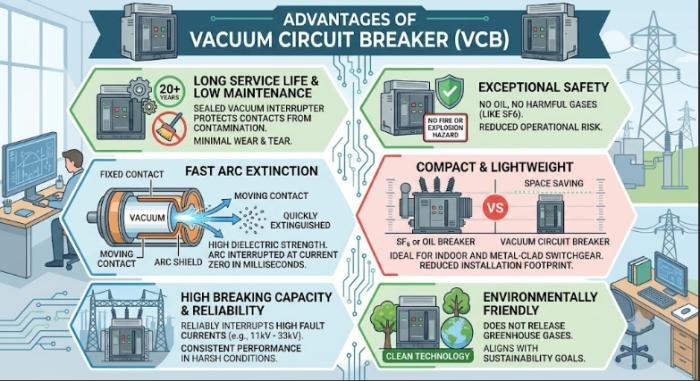
The growing popularity of vacuum technology is largely due to its numerous technical and economic advantages.
Excellent Arc Extinction: The vacuum environment extinguishes electrical arcs extremely quickly. This minimizes contact erosion and improves switching performance.
Long Service Life: Because contact wear is minimal, these breakers can perform thousands of switching operations before requiring major maintenance.
Low Maintenance Requirements: Unlike oil-filled breakers that require regular oil testing or replacement, vacuum interrupters are sealed for life. Routine inspections are generally sufficient to ensure reliable operation.
Environmentally Friendly: Vacuum breakers do not use insulating oil or SF₆ gas, both of which presentenvironmental challenges. This makes them a more sustainable choice for modern electrical systems.
High Operational Reliability: The sealed interrupter protects internal components from moisture, dust, and contaminants, resulting in consistent performance over many years.
Improved Safety: The absence of oil eliminates fire hazards, while the sealed vacuum chamber significantly reduces the risk of arc-related accidents.
Compact Design: Modern vacuum breakers require less installation space than many traditional circuit breakers, making them suitable for compact switchgear installations.
Limitations of Vacuum Circuit Breaker
Although vacuum breakers offer many benefits, they also have some limitations that should be considered during system design.
Higher Initial Investment: The purchase price is often higher than older oil circuit breakers. However, the reduced maintenance costs usually offset this investment over time.
Mainly Used for Medium Voltage: Vacuum technology performs best in medium-voltage applications. Very high-voltage transmission systems may still require alternative technologies depending on network requirements.
Vacuum Integrity Is Critical: The interrupter must remain perfectly sealed throughout its service life. If the vacuum is lost because of physical damage or manufacturing defects, the interrupter must be replaced.
Specialized Repairs: Unlike some conventional breakers, vacuum interrupters are not typically repaired after failure. Instead, the interrupter assembly is replaced, requiring trained maintenance personnel.
How to Choose the Right Vacuum Circuit Breaker
Selecting the correct breaker improves both safety and system reliability. Consider the following factors before making a purchase:
Voltage Rating: Choose a breaker that matches the system’s operating voltage. An incorrect voltage rating can compromise protection performance.
Current Rating: Ensure the breaker can continuously carry the expected load current without overheating.
Interrupting Capacity: The interrupting capacity should exceed the maximum fault current that may occur within the electrical network.
Installation Environment: Determine whether the installation requires an indoor or outdoor model based on environmental conditions.
Switching Frequency: Applications involving frequent motor starting or capacitor switching require breakers designed for higher operating cycles.
Compliance with Standards: Always select equipment certified according to recognized standards such as IEC or IEEE to ensure quality, safety, and reliable performance.
Expert Tip: When sizing a breaker, consider future system expansion as well as current operating conditions. Choosing equipment with a reasonable safety margin can reduce upgrade costs later and improve long-term reliability.
Maintenance Tips for a Vacuum Circuit Breaker
Vacuum circuit breaker requires significantly less maintenance than oil or air circuit breakers, regular inspections are essential for safe and reliable operation. A preventive maintenance program helps identify minor issues before they develop into costly failures.
Perform Visual Inspections
Inspect the breaker periodically for signs of:
- Loose electrical connections
- Dust or dirt accumulation
- Moisture inside the switchgear
- Corrosion or physical damage
- Overheated terminals
Check the Operating Mechanism
The opening and closing mechanism should operate smoothly without excessive force or unusual noise. Inspect:
- Springs
- Linkages
- Bearings
- Mechanical locks
Test Electrical Insulation
Use an insulation resistance tester to verify that insulation levels remain within acceptable limits. Low insulation resistance may indicate moisture, contamination, or insulation aging.
Verify Contact Condition
Although vacuum interrupters experience minimal contact wear, periodic inspection ensures reliable current interruption. Signs of excessive wear include:
- Reduced contact travel
- Increased contact resistance
- Frequent overheating
Functional Testing
Operate the breaker several times during scheduled maintenance to verify correct opening and closing performance. Functional testing confirms that both mechanical and electrical systems remain in proper working condition.
Common Problems and Solutions
Even though vacuum breakers are highly reliable, problems can occasionally occur due to aging, improper installation, or poor maintenance.
| Problem | Possible Cause | Recommended Solution |
| Breaker fails to close | Weak control voltage or faulty coil | Inspect the control circuit and replace damaged components. |
| Frequent tripping | Short circuit or overload | Identify the electrical fault before resetting the breaker. |
| Mechanical operating failure | Worn springs or linkage | Lubricate or replace worn mechanical parts. |
| Contact overheating | Loose electrical connections | Tighten all terminals and inspect contact resistance. |
| Vacuum interrupter failure | Loss of vacuum or physical damage | Replace the interrupter assembly immediately. |
Industry Standards and Safety Guidelines
Quality and safety are essential when selecting or maintaining electrical equipment. Reputable manufacturers design vacuum circuit breakers to comply with internationally recognized standards. Some commonly followed standards include:
- IEC 62271 – High-voltage switchgear and controlgear
- IEEE C37 Series – Standards for circuit breakers and switchgear
- ANSI Standards – Performance and testing requirements
Future Trends in Vacuum Circuit Breaker Technology
The electrical industry continues to adopt smarter and more efficient protection systems. Modern vacuum circuit breakers are increasingly integrated with digital monitoring and automation technologies. Emerging developments include:
- Intelligent electronic trip units
- Remote monitoring through SCADA systems
- Predictive maintenance using sensor data
- IoT-enabled condition monitoring
- Compact eco-friendly switchgear designs
Conclusion
Electrical faults can lead to costly equipment damage, unexpected downtime, and serious safety risks if they are not interrupted quickly and effectively. Choosing the right protection device is essential for maintaining a reliable and efficient power system.
Vacuum circuit breaker addresses these challenges by providing fast arc interruption, low maintenance, long service life, and dependable performance in medium-voltage applications. Throughout this article, you’ve learned its working principle, key components, types, uses, advantages, maintenance practices, and troubleshooting tips to help you make informed decisions.
Whether you’re an engineer, technician, student, or facility manager, understanding how a vacuum circuit breaker operates will help you improve electrical safety, optimize system performance, and ensure long-term reliability in modern power distribution systems.
FAQs about Vacuum circuit breaker
Q1: What is a vacuum circuit breaker?
Ans: A vacuum circuit breaker is a medium-voltage switching device that interrupts fault currents by extinguishing electrical arcs inside a sealed vacuum interrupter.
Q2: How does a vacuum circuit breaker work?
Ans: When a fault occurs, the breaker separates its contacts inside a vacuum chamber. The resulting arc extinguishes rapidly because there are almost no gas molecules to sustain it.
Q3: Where are vacuum circuit breakers commonly used?
Ans: They are widely used in electrical substations, manufacturing plants, commercial buildings, renewable energy systems, mining operations, and railway power distribution networks.
Q4: What are the main advantages of a vacuum circuit breaker?
Ans: Major advantages include low maintenance, long service life, excellent arc-quenching performance, high reliability, compact design, and environmentally friendly operation.
Q5: What voltage range is suitable for vacuum circuit breakers?
Ans: They are primarily used in medium-voltage systems ranging from approximately 3.3 kV to 36 kV, although specialized designs are available for higher voltage applications.
Q6: What causes a vacuum circuit breaker to fail?
Ans: Common causes include loss of vacuum integrity, worn operating mechanisms, damaged control circuits, improper maintenance, and excessive mechanical wear after prolonged service.
Q7: How often should a vacuum circuit breaker be inspected?
Ans: Inspection frequency depends on operating conditions and manufacturer recommendations. Most installations benefit from periodic visual inspections, routine operational tests, and scheduled preventive maintenance.