OFF Grid Solar System: Costs, Benefits & Setup Guide
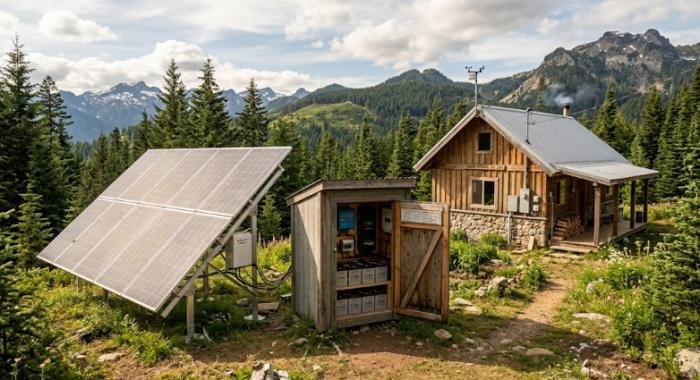
An off grid solar system provides electricity without relying on a utility power connection. Instead of sending solar power to the grid, the system generates electricity locally and typically combines solar panels, batteries, an inverter, and a charge controller to supply power when it is needed. The approach is especially useful for remote homes, cabins, farms, rural properties, and locations where extending utility lines is difficult or expensive.
Unlike a basic solar-panel installation, an off-grid system has to balance electricity generation and consumption throughout the day and night. Solar panels only produce electricity when sunlight is available, so energy storage is normally an important part of the design. The U.S. Department of Energy (DOE) describes stand-alone photovoltaic systems as systems that operate independently and commonly use batteries to store energy for later use.
Read More: How to Use the Instagram Followers Real trick Effectively
What Is an Off Grid Solar System?
An off grid solar system is a solar-electric system designed to operate independently of the utility grid. Solar photovoltaic (PV) panels convert sunlight into direct-current (DC) electricity. A charge controller manages energy going into the battery bank, while an inverter converts DC electricity into alternating-current (AC) electricity for conventional household appliances.
A typical system may also include a backup generator. DOE documentation shows stand-alone configurations using a PV array, batteries, an inverter or inverter/charger, controls, distribution equipment, and sometimes an engine-generator for backup.
The main difference between off-grid and grid-connected solar is energy independence. A grid-connected system can use utility electricity when solar production is insufficient. An off-grid system cannot simply draw power from the grid, so it needs enough generation, storage, or backup capacity to satisfy its loads.
Where Are Off Grid Solar Systems Used?
Off-grid solar is particularly practical where connecting to the utility network is unavailable or costly. Common applications include:
- Remote houses and cabins
- Rural farms and agricultural buildings
- Telecommunications equipment
- Remote lighting
- Emergency and resilience applications
- Small buildings far from electrical distribution lines
- Recreational properties and certain mobile applications
How Does an Off Grid Solar System Work?
The basic energy flow is straightforward: Sunlight → Solar panels → Charge controller → Battery → Inverter → AC appliancesDuring daylight hours, solar panels generate electricity. Some of that electricity can immediately serve household loads, while surplus production charges the battery.After sunset, the panels stop producing electricity.
The battery then supplies stored energy, and the inverter converts the battery’s DC electricity into AC power for appliances that require it.This arrangement makes storage particularly important. DOE explains that solar generation changes with time of day, season, clouds, dust, shadows, rain, and other conditions, while energy storage allows electricity generated at one time to be used later.
What Happens on Cloudy Days?
Solar panels can still generate electricity under cloudy conditions, but their output may be lower than under strong direct sunlight. A correctly designed battery bank can cover some of the shortfall.If poor weather continues for several days, however, battery reserves can become depleted.
This is why off-grid designs often consider several days of autonomy, energy conservation, larger solar arrays, or a backup generator depending on the application.NREL notes that residential off-grid storage can be sized for several days in some applications, while the economically appropriate amount depends on the system and outage or energy requirements.
Main Components of an Off Grid Solar System
Solar Panels: Solar panels, or PV modules, are responsible for converting sunlight into electricity. Multiple modules can be connected to form a solar array with the required voltage and power capacity.Panel performance depends on factors such as sunlight, temperature, orientation, shading, and system design. Avoiding significant shading is particularly important because it can reduce the useful energy produced by an array.
Solar Charge Controller: The charge controller regulates electricity between the solar array and battery bank. It helps control charging conditions and protects the battery from inappropriate charging.Two common controller approaches are PWM and MPPT. MPPT controllers can generally extract energy more effectively under varying operating conditions, although the appropriate choice depends on system voltage, panel configuration, battery characteristics, and cost.
Battery Bank: The battery stores electricity for use when solar production is unavailable or insufficient.Battery specifications should be evaluated using more than nominal capacity. Important considerations include:
- Usable energy capacity
- Maximum charge and discharge power
- Depth of discharge
- Cycle life
- Operating temperature
- Efficiency
- Manufacturer requirements
DOE explains that energy storage has both an energy capacity, usually measured in kWh, and a power capacity, measured in kW. These describe different characteristics and should not be confused.
Inverter: The inverter converts DC electricity from the solar array or batteries into AC electricity for conventional appliances. In an off-grid system, the inverter also has an important role in establishing the electrical characteristics of the local AC supply.A suitable inverter must handle both continuous loads and temporary starting loads. Motors, pumps, refrigerators, compressors, and some other equipment can require considerably more power when starting than during normal operation.DOE technical documentation notes that stand-alone inverters must accommodate current surges such as those produced by motors during startup.
Mounting, Wiring, and Protection Equipment
A complete installation also requires mounting structures, properly sized conductors, disconnects, overcurrent protection, grounding, and appropriate electrical enclosures.These components may not receive as much attention as panels and batteries, but they are essential to safe and reliable operation.
Backup Generator
A generator is not mandatory for every system, but it can be valuable when extended periods of low solar production are possible.In a hybrid off-grid configuration, a generator can supply loads and/or recharge batteries when solar generation and stored energy are insufficient. DOE documentation describes generator-backed stand-alone systems that can start a generator when battery voltage becomes too low.
How to Size an Off Grid Solar System
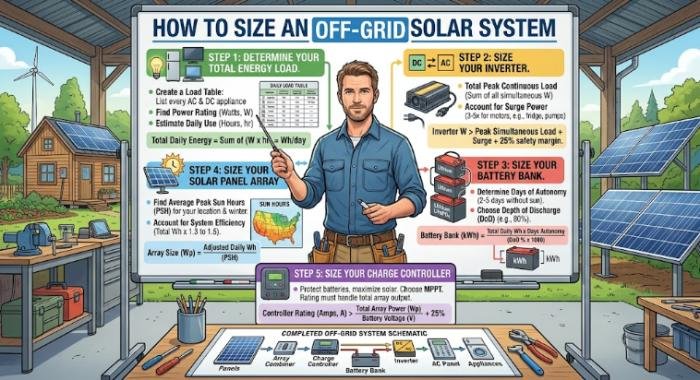
Correct sizing is one of the most important parts of an off-grid installation. There is no single panel or battery size that works for every home.Start by determining how much electricity you actually use.
Calculate Daily Energy Consumption
For each appliance, estimate:
Energy use (kWh) = Power (watts) × Operating time (hours) ÷ 1,000
For example, a 100-watt appliance operating for five hours uses approximately 0.5 kWh.Create a load list containing appliances such as:
- Lights
- Refrigerator
- Fans
- Television
- Computers
- Water pumps
- Kitchen appliances
- Air conditioning
- Washing machines
Determine Peak Power Demand
Daily energy consumption tells you how much energy the system needs over time, but it does not tell you the largest amount of power required at once.For example, several appliances may operate simultaneously, while a refrigerator or pump may require additional starting power.The inverter therefore needs an appropriate continuous rating and sufficient surge capability.
Estimate Solar Array Capacity
Solar array sizing depends on:
- Daily electricity demand
- Local solar resource
- Seasonal conditions
- Panel orientation
- Shading
- Temperature
- Wiring and conversion losses
- Desired battery charging rate
A system should be designed using site-specific solar production estimates rather than assuming that a panel rated at a particular wattage will produce that amount continuously throughout the day.Tools such as NREL’s PV modeling resources can help estimate solar production for a specific location and system configuration.
Size the Battery Bank
Battery sizing should account for daily consumption and how long the system needs to operate when solar generation is limited.A simplified starting point is:
Required nominal storage ≈ Daily energy use × Desired autonomy ÷ Usable battery fraction
This is only a planning equation. Real designs also need to account for battery efficiency, temperature, manufacturer limits, inverter losses, aging, and the distinction between nominal and usable capacity.
Off Grid Solar System Cost
The cost of an off-grid installation varies considerably because the system must be designed around the property rather than purchased as one universal package.
Major cost factors include:
- Solar array size
- Battery capacity
- Battery chemistry
- Inverter size
- Charge controller
- Mounting equipment
- Wiring and protection
- Labor
- Site preparation
- Transportation
- Backup generator
- Permits and inspections
- Local market conditions
Battery storage can be one of the largest cost considerations because an off-grid system needs energy available when the solar array is not producing enough electricity.
| Component | What Determines Its Cost |
| Solar panels | Array size, panel efficiency, brand and installation |
| Batteries | Storage capacity, chemistry, usable capacity and cycle requirements |
| Inverter | Continuous power, surge rating and features |
| Charge controller | PV voltage, current capacity and controller technology |
| Mounting | Roof or ground installation, structure and site conditions |
| Wiring and protection | Cable lengths, voltage, disconnects and electrical requirements |
| Installation | System complexity, labor and site accessibility |
| Backup generator | Generator capacity, fuel type and integration |
How Can You Reduce Off-Grid Solar Costs?
Energy efficiency is often one of the simplest ways to reduce system size.Using efficient lighting, refrigeration, fans, pumps, and other appliances can reduce both solar-array and battery requirements. You can also reduce costs by identifying which appliances genuinely need continuous off-grid power.
Oversizing a system is not automatically better. Excess capacity increases the upfront investment, while undersizing can result in poor reliability and frequent battery depletion.
Benefits of an Off Grid Solar System
Energy Independence: An off-grid installation can produce electricity without depending on a utility connection. This can be especially valuable for properties where grid access is unavailable.
Power for Remote Locations: For a remote property, installing solar and batteries may be more practical than extending electrical infrastructure over a long distance.
Renewable Electricity Generation: Solar PV produces electricity from sunlight without fuel combustion during operation.
Energy Resilience: Solar combined with storage can provide power when conventional electrical service is unavailable. DOE identifies distributed solar and storage as technologies that can strengthen resilience by generating and storing electricity locally.
Flexible System Design: An off-grid system can be designed around a specific set of loads. This makes it possible to prioritize essential equipment rather than attempting to power every appliance regardless of energy demand.
Limitations of an Off Grid Solar System
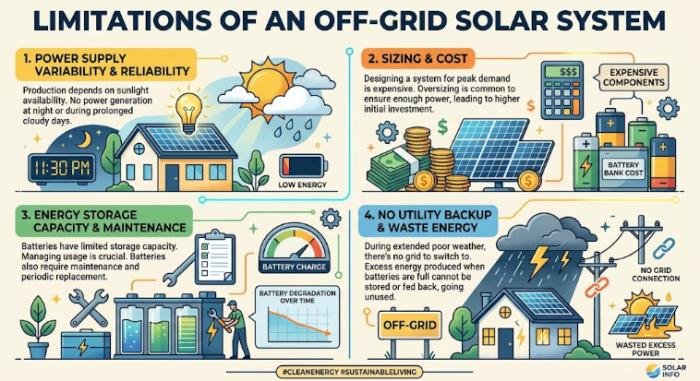
Off-grid solar is not automatically the best option for every property.
Higher Upfront Investment: Compared with a basic grid-connected solar installation, an off-grid system generally requires additional equipment, particularly batteries and off-grid power electronics.
Weather Dependence: Solar production changes with weather and season. A system must be designed to handle periods when generation is below average.
Battery Degradation: Batteries have finite operating lives. Their performance depends on chemistry, temperature, charge and discharge behavior, cycling, and other conditions.
Energy Management: An off-grid homeowner has to pay closer attention to electricity consumption. Running several high-power appliances simultaneously can quickly increase demand.
High-Energy Appliances Can Increase System Size: Electric resistance heating, large air conditioners, electric water heaters, dryers, EV charging, and other high-demand equipment can require substantial generation, storage, and inverter capacity.
Can an Off Grid Solar System Power an Entire House?
Yes, an appropriately designed system can power an entire house, but the required size can be much larger than a system intended for essential loads only.A whole-house design must account for:
- Daily energy consumption
- Peak simultaneous demand
- Appliance starting loads
- Seasonal solar availability
- Battery autonomy
- Heating and cooling
- Water heating
- Cooking
- Backup requirements
What Appliances Can an Off Grid Solar System Run?
An appropriately sized system can operate common household appliances, including refrigerators, lighting, fans, televisions, computers, washing machines, pumps, and kitchen equipment.The important question is not simply whether solar can run an appliance.
It is whether the complete system can provide the appliance’s required power at the required time without compromising the energy reserve needed for other loads.High-power appliances deserve special attention because they can increase both inverter requirements and daily energy consumption.
Off Grid Solar System Installation Process
Step 1: Assess the Property
Evaluate available sunlight, shading, roof or ground space, equipment locations, weather exposure, and accessibility.
Step 2: Measure Electricity Demand
Prepare an appliance inventory and estimate daily kWh consumption. Identify critical loads separately from optional loads.
Step 3: Design the System
Determine appropriate PV capacity, battery storage, inverter rating, charge controller, protection equipment, and backup requirements.
Step 4: Install the Solar Array
Mount the panels securely and connect them according to the electrical design.
Step 5: Install Batteries and Power Electronics
Place batteries and other equipment in locations that meet manufacturer requirements for temperature, ventilation, clearances, and safety.
Step 6: Install Electrical Protection
Install appropriately rated disconnects, overcurrent protection, grounding, and distribution equipment.
Step 7: Commission and Test
The finished system should be tested to verify correct operation, charging, discharging, inverter performance, protection, and monitoring. For complex residential systems, qualified electrical and solar professionals should handle design and installation where required by local regulations.
Off Grid Solar System Maintenance
Solar PV systems generally require less routine mechanical maintenance than fuel-powered generators, but they are not maintenance-free.
Solar Panels: Inspect panels periodically for dirt, physical damage, unexpected shading, or other conditions that could reduce production.
Batteries: Battery maintenance depends strongly on chemistry and manufacturer instructions. Monitor battery temperature, state of charge, alarms, and other available indicators.
Inverter and Electrical Equipment: Pay attention to fault codes, unusual noises, overheating, or abnormal system behavior. Electrical connections and protective equipment should be inspected according to applicable requirements and manufacturer guidance.
Performance Monitoring: Regularly reviewing solar production, battery state of charge, and electricity consumption can reveal problems before they become major failures.
OFF Grid Solar System Safety
Safety should be treated as a core part of system design rather than an afterthought.Solar arrays and batteries can contain hazardous electrical energy even when the utility grid is disconnected. Proper disconnects, overcurrent protection, grounding, wiring, enclosures, and equipment ratings are therefore important.
Battery installations also need to follow manufacturer requirements and applicable electrical and fire regulations. Local rules vary, so homeowners should check the requirements that apply to their property.An experienced installer can also verify that the inverter, batteries, panels, conductors, protection equipment, and distribution system are compatible.
Is an Off Grid Solar System Worth It?
An off grid solar system can be an excellent investment when electricity must be supplied at a remote property or when energy independence is a high priority.It may be less attractive if a reliable grid connection is already available and extending or maintaining that connection is inexpensive.
Before purchasing equipment, consider your actual electricity consumption, solar resource, battery requirements, expected system life, maintenance needs, backup strategy, and local installation costs.The strongest off-grid designs usually begin with reducing unnecessary electricity demand, followed by careful system sizing.
Final Thoughts
An off grid solar system is best understood as a complete energy-management system rather than simply a set of solar panels. Its performance depends on how well solar generation, battery storage, inverter capacity, household demand, and backup resources work together.The most important step is accurate sizing. Start with your real electricity consumption, identify high-power and essential loads, assess the site’s solar resource, and then determine the appropriate solar array and battery capacity.
For remote properties, an intelligently designed system can provide dependable renewable electricity without a utility connection. But reliability comes from good engineering, appropriate equipment, realistic energy expectations, and safe installation—not from simply installing more panels.For technical planning, DOE and NREL resources are useful starting points because they provide established information on PV systems, storage, resilience, system performance, and energy modeling.
Frequently Asked Questions
Q1: What is an off grid solar system?
Ans: An off grid solar system is a solar-electric system that operates independently of the utility grid. It typically combines PV panels, batteries, an inverter, and charge-control equipment to provide electricity without relying on grid power.
Q2: How does an off grid solar system work at night?
Ans: Solar panels do not generate electricity from sunlight after sunset, so the system normally uses energy stored in its batteries. The inverter converts stored DC electricity into AC power for compatible household appliances.
Q3: How much does an off grid solar system cost?
Ans: There is no single price that applies to every property. Cost depends on solar capacity, battery storage, inverter size, installation complexity, backup equipment, local labor, and other site-specific factors.
Q4: Can an off grid solar system power an entire house?
Ans: Yes. A properly designed system can power an entire house, but the required PV array, battery bank, and inverter may become substantial if the home uses large amounts of electricity or high-power appliances.
Q5: How many solar panels are needed for an off grid home?
Ans: The number depends on daily electricity consumption, panel wattage, local sunlight, seasonal conditions, shading, system losses, and desired battery charging capacity. There is no reliable universal panel count for every home.
Q6: How many batteries are needed for an off grid solar system?
Ans: Battery requirements depend on daily energy use, desired autonomy, usable battery capacity, depth-of-discharge limits, efficiency, temperature, and the battery’s power rating. The number of physical batteries cannot be determined from household size alone.
Q7: Can an off grid solar system work during cloudy weather?
Ans: Yes, solar panels can continue producing some electricity during cloudy weather, although output can decrease. Batteries can provide stored energy when solar generation is temporarily inadequate. Extended periods of poor solar conditions may require additional generation or backup power.