Types of Solar System: Types, Uses, Benefits & Costs
Types of solar system energy can be used in several different ways, but not every solar installation is designed to do the same job. Some systems work with the electricity grid, some operate independently, and others combine solar panels with batteries and grid power. Choosing the right setup depends on electricity demand, grid availability, backup requirements, site conditions, and budget.
The phrase types of solar system commonly refers to different configurations of solar photovoltaic (PV) systems. PV technology converts sunlight into electricity, while a complete PV installation also requires equipment such as mounting structures and inverters.
For most homes and businesses, the main configurations are on-grid, off-grid, and hybrid or solar-plus-storage systems. Solar thermal systems, such as solar water heaters, are another category because they use sunlight primarily to produce heat rather than electricity.
Read More: vegamovies hdhub4u: Safety, Legal Status and Alternatives
What Are the Main Types of Solar System?
When discussing solar electricity systems, three configurations are especially important:
- On-grid solar system — connected to the utility grid.
- Off-grid solar system — operates independently of the utility grid.
- Hybrid solar system — combines solar generation, battery storage, and usually a grid connection.
The U.S. Department of Energy also describes PV designs as grid-connected without storage, grid-connected with emergency battery backup, and off-grid with battery storage.
1. On-Grid Solar System
An on-grid, or grid-connected, solar system is connected directly to the local electricity network. It is a common choice for homes, offices, shops, and other properties that already have reliable utility service.Solar panels generate direct-current (DC) electricity. An inverter converts that electricity into alternating current (AC), which can be used by normal household or commercial electrical equipment. When solar production is greater than the property’s immediate demand, excess electricity may be exported to the grid where local utility rules allow it.
How an On-Grid System Works
The basic energy flow is: Solar panels → inverter → building loads → utility gridDuring sunny periods, the solar array supplies electricity to the property. If production is lower than demand, electricity can be supplied by the grid.One important point is often misunderstood: a conventional grid-connected solar system normally does not continue powering a property during a grid outage. Its inverter is designed to stop producing AC power when utility power disappears, helping prevent unsafe electrical backfeeding onto a grid that workers may believe is de-energized.
Benefits of On-Grid Solar
- Works with existing utility infrastructure.
- Does not inherently require a battery bank.
- Can reduce the amount of electricity purchased from the utility.
- Generally has a simpler configuration than a system designed for complete off-grid operation.
- Excess generation may be exported to the grid where permitted.
Limitations of On-Grid Solar
The main limitation is its dependence on the electrical grid when solar production is insufficient. A standard system also cannot automatically provide backup electricity during a grid outage.Local rules concerning interconnection, electricity exports, and compensation vary by location, so homeowners should check with their utility or relevant authority before installation.
2. Off-Grid Solar System
An off-grid solar system operates without a connection to the utility grid. It is particularly useful for remote properties where grid electricity is unavailable, unreliable, or too expensive to extend.Because solar panels only generate electricity when adequate sunlight is available, off-grid systems generally need energy storage. Batteries can store electricity generated during productive periods and make it available later. DOE identifies off-grid PV with battery storage as a distinct system configuration.
How an Off-Grid System Works
A simplified energy path is: Solar panels → charge controller/inverter → battery → electrical loads During daylight, the PV array supplies electricity to the loads and charges the battery. When solar production falls, stored energy can supply the loads.Depending on the installation, an off-grid system may also include a generator or another energy source for periods of unusually high demand or low solar production.
Benefits of Off-Grid Solar
- Can provide electricity in remote locations.
- Does not depend on utility grid availability.
- Can support independent energy supply.
- Useful for cabins, remote facilities, telecommunications equipment, water pumping, and other isolated applications.
Limitations of Off-Grid Solar
Off-grid systems require more careful planning than a basic grid-connected installation. Battery capacity, daily energy consumption, peak loads, seasonal solar availability, and backup requirements all need to be considered.A system that is too small may run out of stored energy, while excessive storage can increase the upfront cost unnecessarily.
3. Hybrid Solar System
A hybrid solar system combines solar PV with battery storage and a grid connection. It can use solar electricity directly, store surplus energy in batteries, and draw from the grid when solar and stored energy are insufficient.Solar-plus-storage systems allow electricity generated during sunny periods to be used later, including after sunset. Storage can also provide backup power when the equipment and system controls are designed for that purpose.
How a Hybrid System Works
A simplified energy flow is: Solar panels → home/business + battery → grid when neededFor example, solar electricity produced during the day can serve immediate loads while charging the battery with surplus generation. Later, stored energy can supply selected loads.During an outage, a properly configured system can disconnect from the utility and operate independently for designated loads. However, simply having solar panels and a battery does not guarantee whole-property backup. The inverter, controls, wiring, battery capacity, and backup-load configuration all matter.
Benefits of Hybrid Solar
- Combines solar generation and battery storage.
- Can shift solar energy to periods without sunlight.
- Can reduce dependence on grid electricity at selected times.
- Can provide backup power when properly configured.
- Offers more flexibility than a basic grid-connected system.
Limitations of Hybrid Solar
The additional battery and control equipment generally makes a hybrid system more complex and more expensive than a basic grid-connected PV system.Battery systems also have finite energy and power capacities. DOE distinguishes energy capacity, normally measured in kWh or MWh, from power capacity, measured in kW or MW. These two specifications answer different questions: how much energy can be stored and how quickly it can be delivered.
How Do Different Types of Solar System Work?
Although the configurations differ, most solar PV systems begin with the same basic process.Solar cells convert sunlight into electricity. Individual cells are connected into modules or panels, and multiple panels can be connected into larger arrays.
The resulting electricity is DC. Most homes and businesses use AC electricity, so an inverter is needed to convert the power into a usable form.The main difference between system types is what happens after electricity is generated.
- On-grid: solar power is used locally and interacts with the utility grid.
- Off-grid: solar power is managed locally, with batteries typically storing energy for later use.
- Hybrid: solar power can serve loads, charge batteries, and interact with the utility grid.
Solar production also changes with weather, time of day, season, shading, dust, rain, and other conditions. Energy storage can help bridge the gap between when solar electricity is produced and when electricity is needed.
Main Components Used in Solar Systems
A solar panel is only one part of a complete solar PV installation. Several other components determine how the system operates.
Solar PV Panels: PV modules contain photovoltaic cells that convert sunlight into electrical energy. Multiple modules can be combined to create an array sized for the property’s electricity requirements.
Panel selection should not be based only on advertised wattage. Available roof area, shading, orientation, system design, local conditions, and expected electricity consumption also matter.
Solar Inverter: The inverter converts DC electricity generated by PV modules into AC electricity for use by appliances and electrical systems. Some systems use one central or string inverter, while others use microinverters attached to individual panels.
Microinverters can allow individual panels to operate more independently, which may be useful where shading affects only part of an array. String inverters can offer a cost-effective configuration, but performance can be affected when a panel within a string experiences certain problems such as shading.
Solar Batteries: Batteries store electricity for later use. They are particularly important for off-grid systems and solar-plus-storage installations.
Storage is not perfectly efficient: some energy is lost during charging, storage, and discharge. Battery sizing should therefore consider actual loads and the desired duration of backup.
Mounting Structures: Panels need a stable structure capable of supporting the array and withstanding environmental conditions. Mounting design can vary between rooftops, ground-mounted arrays, and specialized applications.
Charge Controllers and Electrical Protection: Battery-based systems may use a charge controller, either as a separate component or integrated into other equipment. The controller regulates the electrical conditions used to charge the batteries.
Installations also require appropriate wiring, disconnects, protection equipment, and other balance-of-system components.
Types of Solar System Based on Application
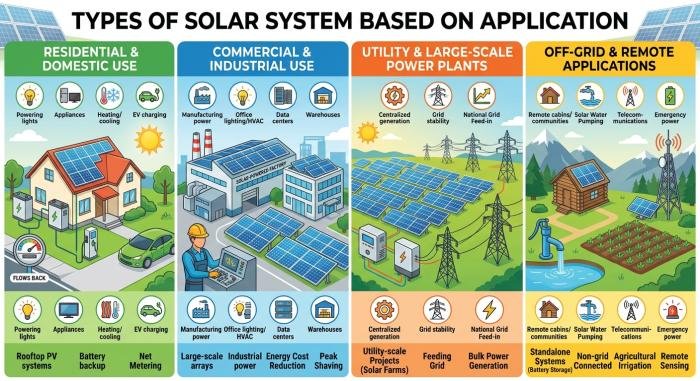
Solar configurations can also be described according to where they are used.
Residential Solar Systems: Residential systems are commonly installed on rooftops or other suitable areas around a home. A grid-connected system may be appropriate when the property has dependable utility service, while a hybrid configuration can make sense when battery storage and backup are priorities.
Commercial Solar Systems: Businesses can use rooftop, ground-mounted, or other PV installations to generate electricity for their operations. Their design may need to account for larger loads, operating schedules, available space, and demand patterns.
Utility-Scale Solar Systems: Utility-scale installations can contain large numbers of PV modules and supply electricity to the wider grid. They may also be paired with large battery storage facilities.
Remote Solar Systems: Remote locations without utility service can use off-grid PV systems with batteries and, where appropriate, supplementary generation.Distributed energy resources such as rooftop solar and batteries can also participate in broader grid and microgrid applications. DOE describes microgrids as localized electrical systems capable of disconnecting from the main grid and operating autonomously.
Solar PV Systems vs Solar Thermal Systems
The term “solar system” can sometimes create confusion because solar technology does not always generate electricity.A solar photovoltaic system converts sunlight into electrical energy. A solar thermal system captures solar energy primarily as heat.Solar water-heating systems, for example, use solar collectors to heat water for residential or commercial use. DOE describes both active and passive solar water-heating approaches.Active Solar Water Heating Active systems use pumps to circulate water or a heat-transfer fluid through the collectors. Direct and indirect configurations are possible.
Passive Solar Water HeatingPassive systems rely on natural circulation rather than mechanical pumps. A thermosiphon system, for example, can use natural convection as heated water rises toward a storage tank.Therefore, PV and solar water heating should not be treated as identical technologies. One primarily generates electricity, while the other primarily supplies heat.
On-Grid vs Off-Grid vs Hybrid Solar System
| Feature | On-Grid | Off-Grid | Hybrid |
| Utility connection | Yes | No | Usually yes |
| Battery storage | Not required | Typically required | Usually included |
| Grid outage backup | Normally no | Yes, if properly designed | Yes, when configured for backup |
| Energy independence | Lower | High | Moderate to high |
| System complexity | Lower | Higher | Higher |
| Common application | Grid-connected homes and businesses | Remote properties | Properties wanting storage and backup |
| Main consideration | Grid dependence | Battery and system sizing | Storage, backup, and grid interaction |
Benefits of Different Types of Solar System
Each configuration solves a different energy problem.
Benefits of On-Grid Solar
On-grid systems can reduce the amount of electricity a property needs to purchase from the utility. They can also avoid the added complexity of a large battery bank when backup power is not a priority.
Benefits of Off-Grid Solar
Off-grid systems can bring electricity to places where utility connections are unavailable. They can provide local energy independence but require enough generation and storage to meet demand.
Benefits of Hybrid Solar
Hybrid systems offer greater flexibility. Solar energy can be consumed immediately, stored for later, or supplemented by grid electricity. Storage can also support resilience during outages when the system has the required backup functionality.
Limitations and Challenges of Each Solar System Type
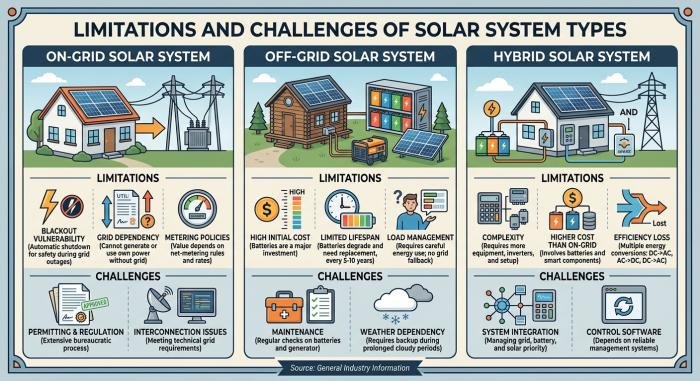
On-Grid Challenges: The system remains dependent on the grid when solar production is insufficient. A conventional grid-tied installation also generally shuts down during an outage.
Off-Grid Challenges: The system must be designed around available solar energy and electricity demand. Battery storage becomes a major part of system sizing and cost.
Hybrid Challenges: Hybrid systems add batteries, controls, and additional equipment. They can therefore require a larger initial investment and more detailed system planning.Solar generation itself is variable. Clouds, shade, dirt, rain, seasonal changes, and time of day can all affect output.
How Much Do Different Types of Solar System Cost?
There is no single reliable price for every solar installation. A realistic cost depends on the location, system size, equipment, installation conditions, battery requirements, local regulations, financing, and other factors.
What Determines Solar System Cost?
- Solar array size
- Panel technology
- Inverter type
- Battery capacity
- Mounting method
- Roof condition
- Electrical upgrades
- Installation labor
- Permits and interconnection
- Local incentives
- Financing terms
- Required backup capacity
Why Off-Grid Systems Can Cost More
Off-grid systems must provide enough energy when solar production is low. That can require additional panels, batteries, backup generation, or other equipment.
Why Hybrid Systems Can Cost More
Hybrid installations add battery storage and equipment capable of managing power between the solar array, battery, property, and grid. The exact architecture can vary. DOE describes both AC-coupled and DC-coupled solar-plus-storage configurations.
What to Compare in Solar Quotes
- Installed PV capacity
- Estimated annual electricity production
- Battery energy and power capacity
- Inverter specifications
- Equipment warranties
- Installation scope
- Expected maintenance
- Financing costs
- Interconnection requirements
Solar System Maintenance and Lifespan
What Maintenance Does a Solar System Need?
Owners should:
- Monitor electricity production.
- Check for unusual performance changes.
- Keep panels reasonably free from excessive dirt or obstructions.
- Inspect equipment according to manufacturer recommendations.
- Follow battery maintenance requirements where applicable.
- Address inverter warnings promptly.
Which Components May Need Replacement?
Solar panels and other components can have long service lives, but not every component necessarily lasts as long as the PV array.DOE notes that inverters may need replacement during the service life of a PV array, making inverter warranties an important part of comparing solar systems.
Battery systems also have their own operating and replacement considerations, which depend on chemistry, usage, temperature, cycling, and system design.
Are Solar Systems Safe During Power Outages?
This is one of the most important questions for homeowners.A conventional grid-connected solar system generally shuts down when the utility grid loses power. This behavior helps prevent the PV system from sending electricity onto lines that utility workers may be repairing.
A solar-plus-storage system can provide backup electricity when it has a properly configured inverter, storage system, controls, and appropriate backup circuits. Advanced inverters can allow solar-plus-storage systems to operate independently from the grid when designed for that purpose.Therefore, solar panels alone should not be assumed to provide blackout protection.
Final Takeaway
The different types of solar system are designed for different energy needs. An on-grid system is generally suited to properties with dependable utility access, an off-grid system is designed for independent operation, and a hybrid system combines solar, storage, and grid electricity for greater flexibility.
The most suitable choice depends on more than the solar panels themselves. Electricity consumption, available sunlight, shading, battery requirements, backup expectations, installation conditions, and local utility rules all influence the final design.
Frequently Asked Questions About Types of Solar System
Q1: What are the main types of solar system?
Ans: The main PV configurations are on-grid, off-grid, and hybrid or solar-plus-storage systems. DOE also describes grid-connected systems without storage, grid-connected systems with emergency battery backup, and off-grid systems with battery storage.
Q2: Which type of solar system is best for a home?
Ans: There is no single best option for every home. An on-grid system can suit a property with reliable utility service, while a hybrid system may be more appropriate when battery storage and backup are priorities. An off-grid system is generally intended for properties without practical grid access.
Q3: What is the difference between on-grid and off-grid solar?
Ans: An on-grid system is connected to the utility network, while an off-grid system operates independently. Off-grid systems generally need batteries because they cannot rely on the utility grid when solar generation is unavailable.
Q4: What is a hybrid solar system?
Ans: A hybrid solar system typically combines PV generation, battery storage, and a utility-grid connection. It can use solar electricity directly, store surplus energy, and draw electricity from the grid when necessary.
Q5: Can an on-grid solar system work during a power outage?
Ans: A conventional grid-tied PV system normally shuts down when the utility grid goes offline. A properly configured solar-plus-storage system can provide backup power using suitable inverter and storage equipment.
Q6: Does an off-grid solar system need batteries?
Ans: Batteries are typically used because solar panels do not produce electricity continuously. Storage allows electricity generated during productive solar periods to be used later when sunlight is unavailable.
Q7: Is a hybrid solar system better than an on-grid system?
Ans: Not necessarily. A hybrid system provides additional flexibility and storage but also adds equipment and cost. If backup power is not important and the grid is reliable, a simpler on-grid system may be sufficient.