Solar Inverter: A Complete Guide to Types, Benefits, Costs, Installation & Maintenance
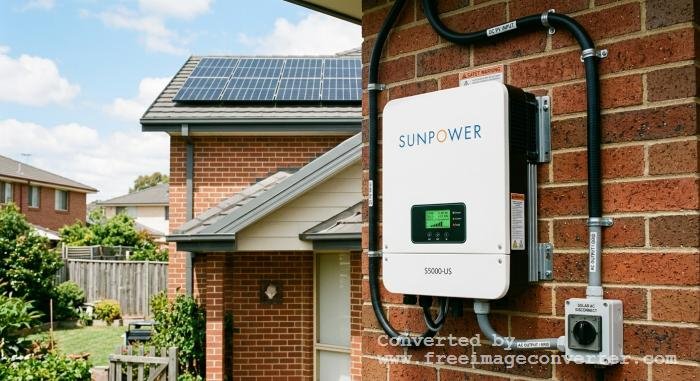
When people think about a solar power system, solar panels are usually the first thing that comes to mind. However, there is another component that plays an equally important role behind the scenes: the solar inverter.Solar panels produce electricity in a form that most household appliances cannot use directly. A solar inverter solves this problem by converting the electricity generated by the panels into usable power for your home, business, battery system, or the electrical grid.
But choosing a solar inverter isn’t simply about buying the cheapest or most powerful model available. The right choice depends on your solar panel capacity, electricity consumption, backup requirements, battery plans, installation environment, budget, and several other factors.In this complete guide, we’ll look at what a solar inverter is, how it works, the different types available, their benefits and costs, installation requirements, maintenance, common problems, and the things you should consider before buying one.
What Is a Solar Inverter?
A solar inverter is an electrical device that converts the direct current (DC) electricity produced by solar panels into alternating current (AC) electricity.Solar panels generate DC electricity when sunlight hits their photovoltaic cells. Most homes, offices, and electrical appliances, however, operate using AC electricity. The inverter performs the conversion that makes solar-generated electricity practical for everyday use.
Modern solar inverters often do much more than simply convert electricity. Depending on the model, they can monitor energy production, manage batteries, communicate with the electrical grid, provide safety protections, and help homeowners understand how their solar system is performing.
You can think of the inverter as the control center of a solar energy system. The panels collect the energy, while the inverter helps turn that energy into something your electrical system can use.
Read More: New York Magazine: History, Journalism and Cultural Impact
How Does a Solar Inverter Work?
The basic process is easier to understand than it may initially sound.First, solar panels absorb sunlight and generate DC electricity. That electricity travels through the solar system to the inverter. The inverter then converts the DC electricity into AC electricity.
Once converted, the electricity can be used to operate appliances such as refrigerators, fans, lights, televisions, computers, pumps, and other electrical equipment.Depending on the type of solar system, electricity that isn’t immediately used can be sent to a battery for storage or, where permitted, exported to the electrical grid. A simplified process looks like this:
Sunlight → Solar Panels → DC Electricity → Solar Inverter → AC Electricity → Home/Business/Battery/Grid
Modern inverters can also continuously monitor voltage, current, temperature, and system performance. If the inverter detects an abnormal condition, it may reduce output or shut down to protect the equipment and people using the system.
Why Is a Solar Inverter Important?
Without an appropriate inverter, the electricity produced by conventional solar panels generally isn’t suitable for directly powering standard AC household appliances. But its importance goes beyond simple conversion.
A quality solar inverter can help manage the flow of electricity throughout the system. It can provide information about energy production, work with battery storage, communicate with other equipment, and include protective features.The inverter can also have a significant influence on the overall performance of your solar installation. That’s why selecting an inverter should be treated as an important system-design decision rather than an afterthought.
Types of Solar Inverters
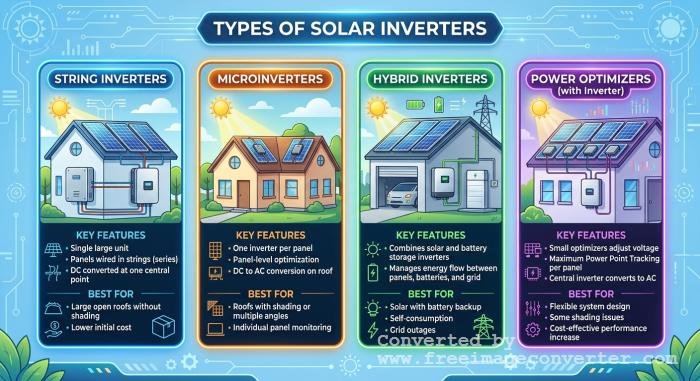
There isn’t one solar inverter that is perfect for every situation. Different inverter designs are intended for different solar configurations and user requirements.
On-Grid Solar Inverter
An on-grid, or grid-tied, solar inverter is designed to work with a utility electricity grid.During periods when the solar system produces enough electricity, your home can use that power. Depending on local rules and system configuration, excess electricity may be exported to the grid.
One important point is that many standard grid-tied systems shut down during a grid outage. This is related to safety requirements designed to prevent a solar system from energizing a grid that may be undergoing maintenance.On-grid inverters are generally attractive for homes that already have reliable grid electricity and want to use solar to reduce their reliance on purchased electricity.
Off-Grid Solar Inverter
An off-grid solar inverter is designed for systems that operate independently of the utility grid.These systems commonly use batteries because electricity needs to be available when solar production is low or when the sun isn’t shining.
Off-grid systems can be useful in remote locations or areas where grid electricity is unavailable or unreliable. However, the system needs to be carefully sized because the battery, inverter, solar panels, and household loads all need to work together.
Hybrid Solar Inverter
A hybrid solar inverter combines functions for solar generation, battery storage, and grid interaction in one system.This makes hybrid systems particularly interesting for homeowners who want flexibility. Solar energy can be used for current loads, stored in a battery, or managed alongside grid electricity depending on the system design.
Hybrid systems can also support backup power when configured with compatible batteries and appropriate backup circuits.
However, a hybrid inverter does not automatically mean that every appliance in the house will remain powered during an outage. Backup capacity depends on the inverter, battery, wiring, and overall system design.
String Inverter
A string inverter connects multiple solar panels together in groups, commonly called strings.This approach is widely used because it can be relatively straightforward and cost-effective.
However, the performance of panels connected to the same string can be affected when some panels experience shading or significantly different operating conditions. String inverters can be a good option for rooftops where panels receive fairly consistent sunlight.
Microinverter
Instead of using one central inverter for multiple panels, microinverters are installed at or near individual solar panels.This arrangement allows each panel to operate more independently. It can be especially useful on roofs where panels face different directions or where partial shading is difficult to avoid.
Microinverters can also provide panel-level monitoring in many systems. The trade-off is that the equipment and installation approach can increase the overall system cost.
Solar Inverter Comparison
| Solar Inverter Type | Best Suited For | Main Advantage | Main Consideration |
| On-Grid Inverter | Homes connected to the grid | Simple grid-connected solar operation | Usually shuts down during grid outages |
| Off-Grid Inverter | Remote or independent systems | Works with standalone battery systems | Requires careful battery and load planning |
| Hybrid Inverter | Homes wanting solar + battery + grid flexibility | Flexible energy management | Higher system complexity and cost |
| String Inverter | Roofs with consistent sunlight | Practical and widely used | Shading can affect string performance |
| Microinverter | Complex or partially shaded roofs | Panel-level operation and monitoring | Can cost more to install |
Benefits of a Solar Inverter
Converts Solar Energy Into Usable Power: The most fundamental benefit is converting DC electricity from the solar panels into AC electricity that typical appliances can use.
Helps Monitor Solar Production: Many modern solar inverters provide monitoring features. Depending on the system, users may be able to see daily energy generation, system status, historical performance, and error notifications.
Supports Battery Storage: Compatible hybrid and off-grid inverters can work with batteries. This allows solar energy to be stored and used later, depending on system design.
Provides Safety Protection: Solar inverters commonly include protective functions designed to respond to electrical faults and abnormal operating conditions.
Can Improve Energy Management: Advanced systems can help coordinate solar generation, battery storage, household consumption, and grid electricity.
Supports Different Solar System Designs: Whether you’re building a simple grid-connected system or a more sophisticated solar-plus-storage installation, there are inverter technologies designed for different requirements.
How to Choose the Right Solar Inverter
Choosing the right solar inverter requires more thought than simply looking at the product price.Start with the size of your solar panel system. The inverter needs to be compatible with the electrical characteristics and capacity of the planned array.
Next, consider your electricity usage. A household with modest daytime consumption may have different requirements from a home with large appliances, pumps, air conditioning, or other high-power equipment.You should also decide whether you need battery storage.
If your main goal is to use solar energy while remaining connected to the grid, an on-grid inverter may be suitable. If you need an independent system, an off-grid solution may be more appropriate. If you want battery storage and grid flexibility, a hybrid inverter could make more sense.Don’t overlook warranty and after-sales support. An inverter is an electronic device that may eventually require service or replacement, so having access to qualified technicians can be just as important as the initial purchase price.
How to Calculate the Right Solar Inverter Size
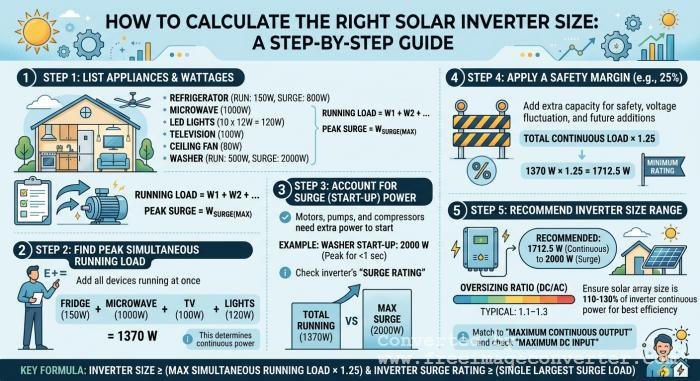
Solar inverter sizing should be based on the complete system rather than one number alone.The solar panel capacity is one important consideration, but so are the inverter’s input limits, output rating, household demand, battery requirements, and potential future expansion.
For example, suppose a homeowner plans a solar array with several kilowatts of panel capacity. That doesn’t automatically mean they should purchase an inverter with exactly the same numerical rating. Solar system designers may use different sizing approaches depending on the equipment, location, expected solar conditions, and system goals.
You should also consider peak loads. Appliances such as motors, pumps, compressors, and some air-conditioning systems can have starting demands that are higher than their normal operating consumption.
Solar Inverter Efficiency Explained
Inverter efficiency describes how effectively the device converts incoming DC electricity into usable AC electricity.No energy conversion process is perfectly lossless, so some energy is lost during operation. A higher-efficiency inverter can reduce these conversion losses. However, efficiency shouldn’t be the only thing you consider.
A slightly more efficient inverter isn’t necessarily the better choice if it doesn’t match your solar panels, battery system, environmental conditions, monitoring needs, or installation requirements. Look at the complete picture: efficiency, reliability, compatibility, warranty, service support, safety features, and total system cost.
Solar Inverter Cost: What Determines the Price?
There isn’t a single price that applies to every solar inverter.The cost can vary depending on the inverter type, capacity, brand, features, installation requirements, and whether battery integration is included. A simple grid-connected inverter can have a very different price from a sophisticated hybrid system designed to manage solar panels, batteries, and backup loads.
Microinverter systems may also have a different cost structure because multiple inverter units are used. Installation is another factor. Electrical work, mounting, wiring, protection equipment, system configuration, and other site-specific requirements can all affect the final project cost. Rather than comparing only the purchase price, consider the total installed cost and long-term value.
Solar Inverter Installation
Solar inverter installation should be handled by a suitably qualified professional because the system involves potentially dangerous electrical voltages and connections.The first step is choosing an appropriate location. The inverter generally needs adequate ventilation and protection from unsuitable environmental conditions.
The installer will then mount the equipment, connect it to the solar array and relevant electrical components, configure the system, and perform testing.For battery or grid-connected systems, additional requirements may apply depending on the equipment and local electrical regulations.
A poor installation location can create unnecessary heat or environmental stress, which may affect equipment performance and longevity. That’s why installation conditions deserve as much attention as the inverter itself.
Solar Inverter Maintenance
Solar inverters are generally designed for long-term operation, but that doesn’t mean they should be ignored after installation. Start by keeping the area around the inverter clean and unobstructed. Don’t place objects directly around ventilation areas if the manufacturer requires airflow.
Regularly monitor the system for unusual behavior. If energy production suddenly drops without an obvious reason, or the inverter repeatedly displays error messages, investigate the issue rather than ignoring it. Homeowners can safely observe many external signs, but internal electrical inspections should be performed by qualified professionals.
Common Solar Inverter Problems
Like any electronic equipment, a solar inverter can experience problems.One common issue is an inverter that doesn’t turn on. This could be related to an electrical supply problem, system fault, protective shutdown, or another issue that requires diagnosis. Error messages are another common occurrence. Modern inverters often display specific codes that help technicians identify the problem.Overheating can also affect performance.
Poor ventilation, excessive ambient temperatures, or an unsuitable installation environment may contribute to thermal issues. Another possibility is unexpectedly low solar output. The cause might not actually be the inverter. Shading, weather conditions, panel problems, wiring issues, or other components can also reduce system production.If an inverter repeatedly shuts down or shows persistent faults, it’s better to have the system professionally inspected instead of repeatedly restarting it without understanding the cause.
How Long Does a Solar Inverter Last?
The lifespan of a solar inverter depends on its design, quality, operating environment, workload, installation conditions, and maintenance.Inverters typically don’t have the same expected service life as solar panels, which is one reason warranty and replacement planning should be part of your long-term solar investment.
Heat can be particularly important for electronic equipment. An inverter installed in a location with poor ventilation or excessive environmental exposure may experience more stress than one installed under suitable conditions. When comparing models, look beyond the headline specifications and examine the warranty, service network, replacement options, and manufacturer’s reputation.
Solar Inverter Warranty: What Should You Check?
Warranty terms can differ considerably between manufacturers and product lines.Before buying, check what the warranty covers, how long it lasts, whether registration is required, and whether labor or replacement costs are included.
Also find out what happens if the inverter fails. Is there a local service provider? How quickly can replacement equipment be obtained?A lower-priced inverter with limited support may not necessarily be the better value if obtaining service becomes difficult later.
Can a Solar Inverter Work During a Power Outage?
This depends on the type of solar system. Many conventional grid-tied solar systems automatically stop operating when the utility grid goes down. This is an important safety function known as anti-islanding protection.
A properly configured battery-backed or hybrid system can provide backup power during an outage, but the exact capability depends on the inverter, battery, backup equipment, wiring configuration, and selected loads.
If backup electricity is important to you, make sure you specifically ask the installer how the system will operate during an outage. Don’t assume that having solar panels automatically means you’ll have electricity when the grid fails.
Do You Need a Battery With a Solar Inverter?
Not every solar system requires a battery. A grid-connected solar system can use solar electricity during the day and interact with the utility grid according to the applicable system design and local rules. A battery becomes more relevant when you want to store solar energy for later use or have backup power during outages.
Battery storage can add flexibility, but it also adds equipment, cost, installation requirements, and another component that needs to be considered when designing the system. The right choice depends on your energy consumption, electricity supply, backup needs, budget, and local conditions.
Final Thoughts
A solar inverter may not be the most visible part of a solar power system, but it is one of the most important. It converts the electricity generated by solar panels into usable AC power, helps manage energy flow, and, depending on the model, can provide monitoring, battery integration, grid interaction, and important protective functions.
The right choice depends on your individual situation. An on-grid inverter may be suitable for one homeowner, while another may benefit more from a hybrid or off-grid system. Before making a purchase, consider the inverter’s compatibility, capacity, efficiency, warranty, installation requirements, battery support, monitoring features, and local service availability.
Most importantly, think about the entire solar system rather than evaluating the inverter in isolation.A well-designed solar system isn’t simply about installing panels on a roof. Every component needs to work together. Choosing the right solar inverter is an important step toward making that system reliable, practical, and suitable for your long-term energy needs.
Frequently Asked Questions About Solar Inverters
Q1: What is a solar inverter?
Ans: A solar inverter is a device that converts the DC electricity produced by solar panels into AC electricity that most homes and appliances can use. Depending on the model, it may also manage batteries, monitor system performance, and provide electrical protection.
Q2: How does a solar inverter work?
Ans: Solar panels generate DC electricity from sunlight. The solar inverter receives that electricity and converts it into AC electricity. The converted power can then be used by appliances, stored in a compatible battery, or supplied to the grid depending on the system configuration.
Q3: Which type of solar inverter is best?
Ans: There is no single best type for every situation. On-grid inverters can suit grid-connected homes, off-grid inverters are designed for independent systems, and hybrid inverters can be useful when solar, battery storage, and grid power need to work together. The best choice depends on your specific requirements.
Q4: How much does a solar inverter cost?
Ans: Solar inverter costs vary based on capacity, type, brand, features, battery compatibility, and installation requirements. Instead of looking only at the equipment price, consider the total installed cost and long-term support.
Q5: Can a solar inverter work without a battery?
Ans: Yes. Many grid-connected solar systems operate without batteries. Batteries are optional in some system designs and are mainly used when energy storage or backup power is desired.
Q6: Can a solar inverter work during a power outage?
Ans: A standard grid-tied inverter will generally shut down during a grid outage for safety reasons. A properly configured hybrid or battery-backed system may provide backup power, depending on its equipment and wiring configuration.
Q7: How long does a solar inverter last?
Ans: The service life varies depending on the inverter’s design, quality, installation environment, operating conditions, and maintenance. Warranty coverage and replacement support should therefore be considered when choosing an inverter.