On Grid Solar System: Cost, Benefits & How It Works and Setup
An on grid solar system is a solar photovoltaic (PV) setup connected directly to the utility electricity grid. Instead of storing all generated electricity in batteries, the system can use solar power in real time, while the grid supplies electricity when solar production is insufficient. Where local regulations allow it, excess solar electricity can also be exported to the grid through an approved metering arrangement.
For homeowners and businesses, this arrangement can be attractive because it combines solar generation with existing grid infrastructure. However, the actual financial benefit depends on factors such as electricity consumption, solar production, installation cost, electricity tariffs, equipment quality, and local rules for exporting electricity.
Read More: Structurespy com: Features, Uses & Website Guide
What Is an On Grid Solar System?
An on grid solar system, also called a grid-tied or grid-connected solar system, generates electricity from photovoltaic panels and connects that generation to the building’s electrical system and the utility grid.
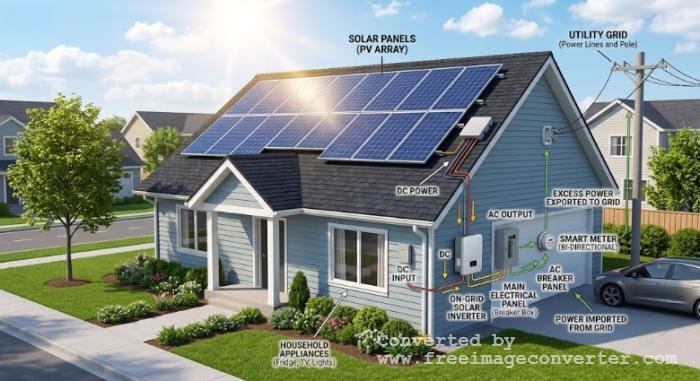
Solar panels produce direct-current (DC) electricity. An inverter converts that electricity into alternating current (AC), which can be used by appliances and electrical equipment in the building. The system also manages its interaction with the utility grid. The basic concept is straightforward:
Sunlight → Solar panels → Inverter → Building loads → Utility grid
When solar production is higher than the building’s immediate electricity demand, the surplus may be exported to the grid if the system is approved for such operation. When solar production is lower than demand, electricity can be imported from the grid.
How Does an On Grid Solar System Work?
The operation of an on grid solar system involves several stages.
1. Solar Panels Generate Electricity
Photovoltaic modules contain solar cells that convert sunlight into electrical energy. The electricity produced by the modules is DC electricity.The amount generated varies throughout the day and depends on sunlight availability, weather, shading, panel orientation, temperature, and other operating conditions. Solar panels therefore do not produce their rated output continuously.
2. The Inverter Converts DC to AC
The electricity produced by the panels cannot normally be used directly by standard household and commercial AC equipment. The inverter converts the panels’ DC output into AC electricity.An inverter is also an important part of grid integration because it controls how the solar system interacts electrically with the utility network. Modern inverters can include monitoring and grid-support functions in addition to basic DC-to-AC conversion.
3. Solar Electricity Supplies Local Loads
If appliances are operating while the solar system is generating electricity, the building can use that solar generation.For example, during a sunny afternoon, solar electricity may help power air conditioners, computers, pumps, lighting, refrigerators, and other electrical loads.Using solar generation directly at the premises can reduce the amount of electricity that needs to be purchased from the grid.
4. Surplus Electricity Can Go to the Grid
If the solar system generates more electricity than the building is consuming at that moment, the excess can flow toward the utility grid when the system has the necessary interconnection and metering approval. The financial treatment of exported electricity depends on the local electricity regulations. It should not be assumed that every country or utility compensates exported electricity in exactly the same way.
5. The Grid Supplies Additional Electricity
Solar production changes with sunlight. At night, for example, the panels do not generate electricity. During periods of low solar production, the building can obtain electricity from the utility grid. This is one of the major practical advantages of a grid-connected arrangement: the grid can complement variable solar generation.
What Are the Main Components of an On Grid Solar System?
A properly designed system contains more than solar panels. The major components work together to generate, convert, protect, monitor, and distribute electricity.
Solar PV Panels: PV panels are responsible for converting sunlight into DC electricity. Panel selection involves factors such as rated power, efficiency, physical dimensions, product specifications, warranty terms, and applicable certification.
On Grid Solar Inverter: The inverter converts DC electricity into AC electricity and provides the interface between the PV system and the building/grid.String inverters and microinverters are two common configurations. A central or string inverter can serve multiple modules, while a microinverter is installed at individual modules. The best configuration depends on system design, shading, roof layout, equipment specifications, and project requirements.
Mounting Structure: Panels require a stable structure capable of supporting them under environmental conditions such as wind and rain. Roof structure, orientation, available space, tilt, and access for maintenance all need consideration. The U.S. Department of Energy notes that PV mounting structures must be durable and designed to withstand environmental exposure over long periods.
DC and AC Electrical Protection: Depending on the system design and applicable electrical standards, protection and isolation equipment may include disconnects, circuit protection, surge protection, grounding or earthing provisions, and appropriate cabling. These components should be selected and installed according to applicable electrical requirements rather than simply choosing the cheapest available equipment.
Metering Equipment: Grid-connected systems may require specific metering arrangements. In a net-metering setup, a bidirectional meter can record electricity imported from and exported to the grid.
Monitoring Equipment: Many modern inverters provide monitoring through a display, website, or mobile application. Monitoring can help users track generation and identify abnormal system behavior.
Can an On Grid Solar System Work Without Batteries?
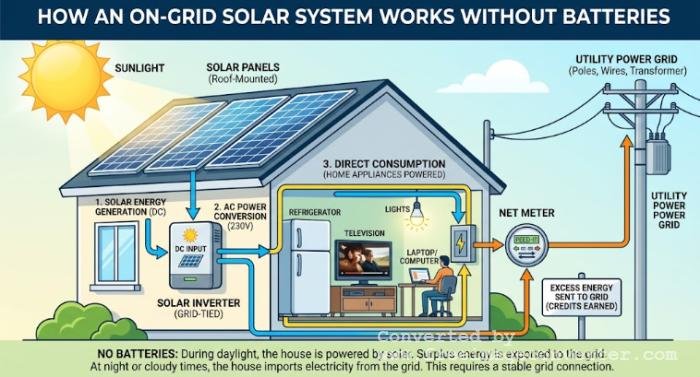
Yes. A conventional on grid solar system can operate without batteries. This is one of its main differences from many off-grid systems. Instead of storing daytime solar electricity for later use, a grid-connected system can use available solar electricity immediately and interact with the utility grid according to applicable rules.
What Happens at Night?
Solar panels stop producing electricity when there is no sunlight. The building can then receive electricity from the utility grid.If battery storage is added, stored energy can instead be used during suitable periods, including nighttime. The Department of Energy describes batteries as a means of storing solar electricity for later use.
Why Add Batteries to a Grid-Tied System?
Battery storage may be considered when the user wants:
- Backup power
- Greater control over when solar electricity is used
- More evening consumption from stored solar energy
- Energy management during certain tariff periods
- Additional resilience during grid interruptions
On Grid Solar System Cost: What Determines the Price?
There is no single price that accurately applies to every on grid solar system. A reliable cost estimate requires information about the property, electricity consumption, system capacity, equipment, labor, and local regulations. The main cost factors include:
- Solar panel capacity and quantity
- Inverter type and capacity
- Mounting structure
- DC and AC cabling
- Electrical protection equipment
- Monitoring equipment
- Roof preparation or structural work
- Installation labor
- Utility interconnection requirements
- Metering costs
- Permits and applicable fees
- Taxes and transportation
- Warranty and after-sales services
Does a Larger System Always Cost More?
A larger system normally requires more equipment, although the cost per unit of capacity can vary between projects.Instead of choosing a system based solely on the lowest quoted price, compare the complete installation scope, equipment specifications, warranties, expected production, workmanship, and service support.
What Should a Solar Quote Include?
A professional quotation should clearly identify the proposed panel models, total PV capacity, inverter model and capacity, mounting arrangement, protection equipment, installation work, monitoring system, warranties, utility-related work, and applicable taxes or fees. That information makes it much easier to compare competing quotations fairly.
On Grid Solar System Net Metering Explained
Net metering allows eligible consumers with renewable-energy generation systems to use electricity generated at their premises and, under applicable rules, export surplus electricity to the distribution grid.
In Bangladesh, the Sustainable and Renewable Energy Development Authority (SREDA) published Net Metering Guidelines–2025 in August 2025. The official guideline describes a bidirectional metering arrangement that accounts for electricity imported from and exported to the grid and provides for credit/settlement mechanisms under the guideline.
The important point is that net metering is not simply the same everywhere. Eligibility, system capacity, meter configuration, export treatment, settlement periods, and application procedures depend on the applicable jurisdiction and utility.
How Does Net Metering Work?
A simplified example is:
- Solar panels generate electricity.
- The building consumes part of that electricity.
- Any eligible surplus is exported to the grid.
- The meter records relevant electricity flows.
- Imported and exported energy are treated according to the applicable net-metering rules.
- Credits or payments are settled according to the relevant policy.
Benefits of an On Grid Solar System
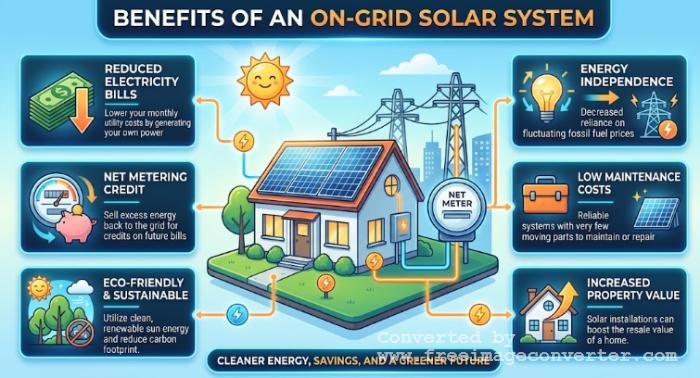
An on grid solar system can offer several practical advantages.
Reduced Grid Electricity Consumption: Solar generation can offset electricity that would otherwise need to be purchased from the grid. The actual reduction depends on system size, solar production, electricity demand, and when the building uses electricity.
No Battery Required for Basic Operation: A standard grid-connected PV system does not necessarily need batteries. This can simplify the installation compared with a battery-dependent off-grid system.
Potential Export of Surplus Electricity: Where regulations permit, surplus generation can be exported to the grid under an approved metering and interconnection arrangement.
Uses Existing Grid Infrastructure: The utility grid can provide electricity when solar production is insufficient, making the system practical for properties that already have a reliable grid connection.
Renewable Electricity Generation: Solar PV generates electricity without the direct combustion of fuel at the point of generation. It can therefore contribute to a broader transition toward renewable electricity.
Limitations of an On Grid Solar System
Despite its advantages, an on grid solar system is not suitable for every requirement.
Standard Systems Usually Do Not Provide Backup During an Outage
A common misconception is that solar panels automatically keep a house powered when the grid fails.A conventional grid-connected inverter is designed to stop supplying the grid when utility power is unavailable. This is related to grid safety and anti-islanding requirements. Bangladesh’s National Solar Help Desk also specifies standards concerning grid-tied inverter safety and islanding prevention.A system intended to provide backup requires an appropriately designed storage and inverter arrangement.
Solar Production Is Variable
Solar output changes with:
- Time of day
- Cloud cover
- Weather
- Shading
- Temperature
- Panel orientation
- Soiling
Upfront Investment Is Required
Panels, inverter, mounting structures, electrical equipment, installation, and grid-related work require an initial investment.
Export Rules Affect Financial Returns
If exported electricity is credited differently from electricity consumed directly, the timing of electricity consumption becomes important when evaluating the economics of a project.
On Grid vs Off Grid Solar System
| Feature | On Grid Solar System | Off Grid Solar System |
| Utility grid connection | Yes | No |
| Battery required | Not necessarily | Usually required |
| Grid outage operation | Standard systems generally shut down | Designed for independent operation |
| Excess solar | May be exported where permitted | Usually stored, used, or curtailed |
| Main purpose | Reduce grid electricity use | Provide electricity without relying on the grid |
| Backup capability | Requires suitable additional equipment | Normally part of system design |
On Grid Solar System Installation and Setup
A professional installation should follow a planned sequence rather than simply mounting panels and connecting wires.
Step 1: Assess the Site
Evaluate roof condition, usable space, shading, orientation, electrical infrastructure, and access.
Step 2: Analyze Electricity Consumption
Review historical electricity bills and determine how much electricity the property uses.
Step 3: Design the System
Select appropriate panel capacity, inverter configuration, mounting system, wiring, protection equipment, and monitoring solution.
Step 4: Complete Utility Requirements
Where required, submit the relevant application and technical documentation for grid interconnection and net metering.
Step 5: Install the Mounting Structure and Panels
The mounting system should be securely installed and appropriate for the roof or ground conditions. Panels are then positioned according to the approved design.
Step 6: Install the Inverter and Electrical Equipment
The inverter and associated electrical equipment are installed according to manufacturer instructions and applicable electrical standards.
Step 7: Test and Commission the System
The installer should verify electrical connections, protection, inverter operation, monitoring, and grid-interconnection functions.
Step 8: Complete Metering and Grid Connection
Where applicable, the utility completes or approves the required meter and interconnection arrangements before the system operates as an approved grid-connected generator.
How Much Roof Space Does an On Grid Solar System Need?
Roof requirements depend on the physical dimensions and power rating of the selected panels, as well as the layout of the installation. A simple panel-count calculation is not enough because installers must also consider shading, roof obstacles, access, spacing, structural conditions, and equipment placement. For this reason, two systems with the same nominal capacity may require somewhat different usable roof areas.
On Grid Solar System Maintenance
Solar PV systems generally require less routine maintenance than many conventional electricity-generation systems, but they should not be ignored after installation.
Panel Inspection: Periodically inspect panels for visible damage, unusual soiling, or physical problems.
Inverter Monitoring: Check the inverter’s status and monitoring platform for error messages or unexpected changes in production.
Electrical Inspection: Qualified personnel should inspect relevant electrical connections, protection equipment, cables, and grounding/earthing arrangements when required.
Compare Actual and Expected Production: Monitoring historical production can help identify potential problems. A sudden unexplained decline may justify professional inspection.The inverter may also have a different expected service life from the PV modules. The Department of Energy notes that an inverter may need replacement during the lifetime of a PV array, so long-term planning should account for individual component lifetimes rather than treating the entire system as a single device.
Final Thoughts on On Grid Solar System
An on grid solar system can be a practical way to generate renewable electricity while remaining connected to the existing utility network. Its basic operation is straightforward: solar panels generate DC electricity, an inverter converts it to AC, the building uses available solar power, and the grid supplies additional electricity when necessary.
The biggest advantages are the ability to reduce grid electricity consumption and, where permitted, export surplus generation without necessarily requiring batteries. However, a standard grid-tied system should not be treated as an automatic backup solution during blackouts.
Cost, system size, expected production, roof conditions, equipment quality, utility requirements, and net-metering rules all matter when evaluating a project. In Bangladesh particularly, current SREDA guidance should be checked because the Net Metering Guidelines–2025 now provide the relevant updated framework.
Frequently Asked Questions About On Grid Solar System
Q1. What is an on grid solar system?
Ans: An on grid solar system is a photovoltaic system connected to the utility electricity grid. Solar panels generate DC electricity, an inverter converts it to AC, and the electricity can serve local loads. Depending on local rules, surplus generation may also be exported to the grid.
Q2. Does an on grid solar system need batteries?
Ans: No. A standard grid-connected PV system can operate without batteries. The grid supplies electricity when solar production is insufficient. Batteries can be added when backup or energy storage is required.
Q3. Can an on grid solar system work during a power outage?
Ans: A conventional grid-tied system generally shuts down when the utility grid goes offline. This prevents unintended energization of the grid. Backup operation requires a suitable system specifically designed for that purpose.
Q4. How much does an on grid solar system cost?
Ans: Cost depends on system capacity, panels, inverter, mounting structure, electrical equipment, labor, roof conditions, utility requirements, taxes, and other project-specific factors. A site-specific quotation is more reliable than a universal price.
Q5. How does net metering work with an on grid solar system?
Ans: Solar electricity first serves the property’s eligible electricity demand. Surplus electricity can be exported to the grid when permitted. A suitable meter records electricity flows, and credits or settlements are handled according to the applicable net-metering rules.