Solar Rooftop Price List: 1kW to 10kW Cost & Subsidy
Solar rooftop price list can reduce electricity bills, but the biggest question for most homeowners is simple: How much will a rooftop solar system actually cost? With different panel brands, system sizes, installation charges, batteries, and government subsidies, comparing a solar rooftop price list can quickly become confusing. A low quotation may not include everything you need, while a higher price does not always guarantee better value.
Important numbers together in one place, covering 1 kW to 10 kW system prices, subsidy benefits, installation costs, expected generation, and buying factors. The goal is to help you estimate your investment and choose the right solar system confidently.
Read More: Instagram Reels Algorithm: How Small Creators Get More Reach 2026
Solar Rooftop Price List in India
If you are planning to install solar panels at home, price is usually the first question: How much will a rooftop solar system actually cost?
The answer depends on system capacity, panel technology, inverter, mounting structure, installation requirements, location and whether you need batteries. There is no single nationwide retail price that applies to every rooftop.
As a practical 2026 market reference, residential on-grid rooftop installations are commonly quoted at roughly ₹55,000–₹85,000 per kW before subsidy, although individual quotations can fall outside this range. Recent market estimates put typical 3 kW systems around ₹1.5 lakh–₹2 lakh before subsidy, depending on specifications and installer.
The government subsidy can substantially reduce the effective cost for eligible residential consumers under PM-Surya Ghar. Here is a useful starting point for comparing prices:
| Solar System Size | Indicative Residential Price Before Subsidy | Central Subsidy* | Approx. Price After Central Subsidy* |
| 1 kW | ₹55,000–₹85,000 | Up to ₹30,000 | ₹25,000–₹55,000 |
| 2 kW | ₹1.10–₹1.50 lakh | Up to ₹60,000 | ₹50,000–₹90,000 |
| 3 kW | ₹1.50–₹2.00 lakh | Up to ₹78,000 | ₹72,000–₹1.22 lakh |
| 5 kW | ₹2.50–₹3.50 lakh | Up to ₹78,000 | ₹1.72–₹2.72 lakh |
| 10 kW | ₹5.00–₹7.00 lakh | Up to ₹78,000 | ₹4.22–₹6.22 lakh |
1 kW Solar System Price
A 1 kW system is suitable for households with relatively modest electricity consumption. A typical residential 1 kW on-grid installation may cost around ₹55,000 to ₹85,000 before subsidy. After an eligible central subsidy of up to ₹30,000, the effective cost can be considerably lower.
However, choosing 1 kW simply because it is cheaper is not always the best decision. If your household consumes considerably more electricity, a larger system may provide better long-term savings.
2 kW Solar System Price
A 2 kW rooftop system generally costs around ₹1.10 lakh to ₹1.50 lakh before subsidy, depending on the equipment and installation.
Under the central PM-Surya Ghar structure, the first 2 kW receives CFA based on 60% of the applicable benchmark cost, resulting in a maximum central subsidy of ₹60,000 for this capacity.
For a family with moderate electricity usage, 2 kW can be a practical middle ground between installation cost and generation.
3 kW Solar System Price
The 3 kW category is particularly important for residential buyers because it reaches the maximum central subsidy level under the current PM-Surya Ghar structure. Market quotations for a 3 kW residential on-grid system commonly fall around ₹1.50 lakh to ₹2 lakh, although premium equipment, difficult roofs or additional electrical work can push the quotation higher.
The central subsidy can reach ₹78,000 for an eligible 3 kW residential system. MNRE’s scheme structure provides CFA for the first 2 kW and an additional 1 kW, with no additional central CFA beyond 3 kW.
5 kW solar rooftop price list
A 5 kW system may cost roughly ₹2.50 lakh to ₹3.50 lakh before subsidy. Although the system is substantially larger than 3 kW, the central subsidy does not continue increasing after 3 kW. That means a 5 kW buyer may still receive a maximum central CFA of ₹78,000 under the residential scheme structure.
A 5 kW system can make sense for larger homes with higher consumption, especially where daytime electricity use is significant.
10 kW Solar rooftop price list
A residential 10 kW rooftop installation can cost approximately ₹5 lakh to ₹7 lakh or more, depending on the equipment and project requirements.
The larger system may produce considerably more electricity, but the central residential subsidy remains capped at the applicable 3 kW level. Therefore, buyers should not assume that installing a 10 kW system means receiving ten times the subsidy.
For systems of this size, roof area, sanctioned electrical load, inverter configuration and local DISCOM requirements become increasingly important.
What Does a Rooftop Solar System Cost Include?
A good solar quotation should not simply say “3 kW solar system – ₹X.” You should know what is included in that figure.
Solar Panels
Solar modules are one of the largest components of the system. Modern residential systems may use mono-crystalline technologies such as TOPCon or other approved module technologies. Panel efficiency, manufacturer, warranty, electrical characteristics and eligibility under applicable government requirements can affect the price.
For installations seeking government assistance, check whether the proposed modules satisfy the relevant scheme requirements. MNRE’s current guidance includes domestic-content requirements for modules used for CFA eligibility under PM-Surya Ghar.
Solar Inverter
The inverter converts the DC electricity produced by the panels into AC electricity used by household appliances. A low-cost inverter can make a quotation look attractive, but the inverter is an important long-term component. Compare efficiency, warranty, service availability, monitoring features and the number of MPPTs rather than choosing solely on price.
Mounting Structure
Panels need a properly engineered structure that can withstand local weather conditions. The cost can increase when the roof requires elevated structures, special fabrication, additional reinforcement or a more complicated installation.
Wiring, Protection and Earthing
A professional installation should account for appropriate DC and AC cables, protection devices, earthing, connectors and related balance-of-system components. These items may represent a smaller part of the total quotation, but they have a major impact on electrical safety and system reliability.
Installation and Commissioning
Labour, transportation, installation, testing, commissioning and support with applicable DISCOM procedures can also form part of the final price. Always ask the installer for a written scope of work so you know exactly what you are paying for.
PM-Surya Ghar Subsidy for Rooftop Solar

The PM-Surya Ghar: Muft Bijli Yojana is the central government programme supporting residential rooftop solar adoption. The scheme was approved with a total financial outlay of ₹75,021 crore and aims to support rooftop solar installations in one crore households. For eligible residential consumers, the central financial assistance structure is:
- Up to 2 kW: 60% of the applicable benchmark cost
- Additional 1 kW: 40% of the applicable benchmark cost
- Beyond 3 kW: no additional central CFA
- Maximum central residential CFA: ₹78,000
The actual subsidy is not simply a discount that every installer can apply however they want. Installation, verification and other scheme requirements must be followed.
On-Grid vs Off-Grid vs Hybrid Solar Prices
The system type has a major effect on your final solar rooftop price.
On-Grid Solar
An on-grid system works alongside the electricity grid. It normally does not include a battery, which keeps the upfront price comparatively low. Excess electricity may be exported according to the applicable net-metering arrangement and local DISCOM rules. 4For a home with a reliable grid connection, an on-grid system is often the most economical choice.
Off-Grid Solar
An off-grid system operates independently from the electricity grid and normally requires batteries. The battery bank can significantly increase the upfront investment. Battery replacement also needs to be considered when calculating long-term ownership costs. Off-grid systems can make more sense in locations where grid electricity is unavailable or unsuitable.
Hybrid Solar
A hybrid system combines solar generation, grid connectivity and battery storage. It can provide backup during outages while allowing the household to use solar energy during normal operation. The main disadvantage is cost. Adding batteries, a suitable hybrid inverter and associated equipment can substantially increase the initial investment.
How to Choose the Right Solar Capacity for Your Home
Do not select a solar system based only on the price of panels. Start with your electricity bills. Check your average monthly consumption over the previous 12 months. Then consider whether your electricity usage is likely to increase because of an air conditioner, refrigerator, water pump, electric vehicle or other appliances.
For example: a household using relatively little electricity may not need a 5 kW system. Conversely, installing only 1 kW when the household has consistently high consumption may leave substantial electricity demand uncovered.
Roof space also matters. Shading from trees, neighboring buildings and rooftop structures can reduce actual generation.
The best capacity is therefore a balance between electricity consumption, available roof area, budget, local regulations and expected future usage.
Factors That Change Rooftop Solar Prices
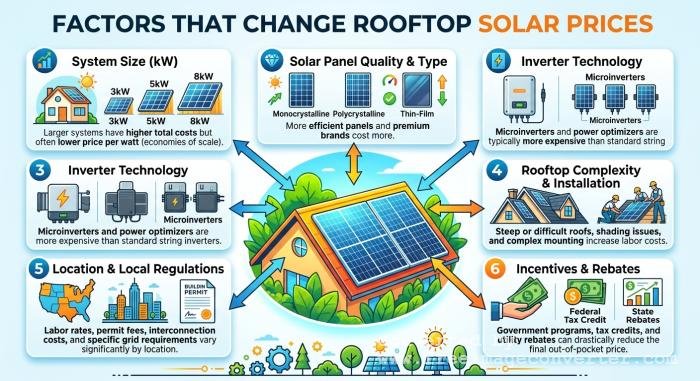
Two households can receive very different quotations for systems with the same capacity. Several factors explain the difference.
Panel brand and technology: Higher-quality or newer-generation modules can cost more.
Inverter specification: Inverter efficiency, warranty, monitoring and MPPT configuration affect pricing.
Roof type: A simple concrete roof may require less work than a sloped, elevated or structurally complicated roof.
Installation location: Labour, transport and local market conditions vary between cities and states.
Electrical work: Older wiring, earthing improvements, protection equipment or electrical-panel upgrades can increase costs.
Battery storage: Adding batteries can substantially increase the total investment.
Government eligibility: Systems installed under government programmes may need to satisfy specific equipment and vendor requirements.
How Much Electricity Can a Rooftop Solar System Generate?
Solar generation depends on location, sunlight, orientation, tilt, temperature, shading, system losses and equipment performance. As a broad planning estimate, a 1 kW rooftop system may produce roughly 3–5 units of electricity per day on average in many Indian locations, but actual output varies throughout the year.
That means a 3 kW system might generate roughly 9–15 units on a good average day under suitable conditions. These numbers should be treated as estimates rather than guaranteed production. A professional installer should ideally assess the roof and provide an expected generation calculation based on the actual site.
How to Compare Solar Quotes Before Buying
The cheapest quotation is not automatically the best quotation. Suppose one installer quotes ₹1.55 lakh for a 3 kW system while another quotes ₹1.85 lakh. Before choosing the cheaper option, compare the actual equipment and services. Ask both installers:
- Which solar panel model is included?
- Is the module eligible under applicable subsidy requirements?
- Which inverter model will be installed?
- What warranties are provided?
- What type of mounting structure is included?
- Are DC and AC protection devices included?
- Is earthing included?
- Is installation included?
- What support is provided for DISCOM procedures?
- What happens if a component fails?
- Is monitoring included?
- Are taxes and transportation included?
- Is battery storage included or excluded?
- What maintenance support is provided?
Is Rooftop Solar Worth the Investment?
For many households, rooftop solar can provide meaningful long-term electricity savings, particularly when the system is properly sized and the roof receives good sunlight. But the financial result depends on several variables:
- Your electricity tariff
- Monthly consumption
- Solar generation
- System cost
- Subsidy eligibility
- Net-metering arrangements
- Maintenance costs
- Future electricity prices
- Equipment lifespan
Instead of asking only, “What is the cheapest solar system?”, ask, “Which system gives me the best balance of price, reliability, generation and long-term savings?” A slightly more expensive system with better components and installation may deliver better value than the cheapest quotation.
Final Thoughts
Choosing rooftop solar can feel confusing when prices differ between installers and hidden costs, equipment quality, and subsidy rules can change the final investment. The solution is not simply choosing the cheapest quotation, but comparing system capacity, panels, inverter, installation, warranty, generation potential, and eligible government subsidy together. This article has provided the solar rooftop price list, cost estimates, subsidy information, and practical buying factors to make that comparison easier. Use these figures as a starting point, obtain multiple quotations, verify current government requirements, and choose a reliable system that can deliver dependable savings for years.
FAQs about solar rooftop price list
Q1: What is the solar rooftop price list in India for 2026?
Ans: Residential rooftop solar generally costs ₹55,000–₹85,000 per kW before subsidy, depending on system size, equipment and installation.
Q2: What is the price of a 1 kW rooftop solar system?
Ans: A 1 kW on-grid system typically costs ₹55,000–₹85,000 before subsidy, with eligible households receiving applicable government assistance.
Q3: How much does a 3 kW solar system cost after subsidy?
Ans: A 3 kW system may cost ₹1.50–₹2 lakh before subsidy, with eligible buyers receiving up to ₹78,000 central CFA.
Q4: What is the maximum PM-Surya Ghar subsidy for a home?
Ans: Eligible residential consumers can receive maximum central CFA of ₹78,000 for rooftop solar systems under the current PM-Surya Ghar structure.
Q5: Is a 5 kW solar system eligible for more subsidy than a 3 kW system?
Ans: No. Central residential subsidy is capped at the amount applicable to 3 kW, even when installing a larger system.
Q6: Which is cheaper, on-grid or off-grid solar?
Ans: On-grid solar is generally cheaper because it usually operates without batteries, while off-grid systems require costly energy storage.
Q7: Is a battery included in the normal rooftop solar price?
Ans: Usually not. Standard on-grid systems generally exclude batteries, so check whether battery storage and backup equipment are included.