How Many Balls Were Originally There in One Test Over? The Complete History & Why It Changed
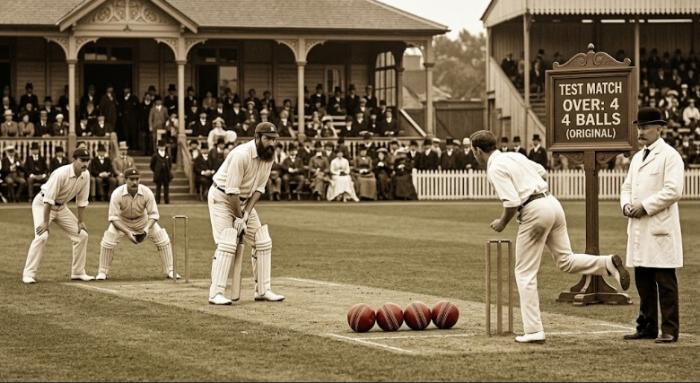
If you’ve ever watched a Test cricket match, you probably know that an over consists of six legal deliveries. It feels so natural today that many fans assume cricket has always followed this rule. But that isn’t true. One of the most fascinating facts about cricket history is that the number of balls in an over has changed several times over the last two centuries.
How many balls were originally there in one Test over? The answer surprises many cricket lovers. When the first official Test match was played between Australia and England in 1877, an over consisted of just four balls. Over the years, different cricket-playing nations experimented .
With five-ball, six-ball, and even eight-ball overs before the International Cricket Council (ICC) finally adopted the six-ball over as the worldwide standard. Understanding this evolution offers more than just a history lesson. It helps explain why old cricket records look different .
why match strategies evolved, and how the sport became more balanced for players, officials, broadcasters, and fans. In this article, you’ll discover the complete history of Test cricket overs, why the rules changed, which countries used different over lengths, and how the modern six-ball over became one of cricket’s defining features.
Read More: Earnstark com Review Make Money, Features & Safety Guide
how many balls were originally there in one test over? What Is an Over in Test Cricket?
Historical over length, it’s important to understand what an over actually is. In cricket, an over is a set of legal deliveries bowled by one bowler from one end of the pitch. Once the over is complete, another bowler delivers the next over from the opposite end.
However, not every ball counts toward an over. Deliveries called as no-balls or wides must be bowled again because they are considered illegal deliveries. An over serves several important purposes:
- It organizes the flow of the game.
- It determines bowling rotations.
- It allows captains to plan field placements.
- It creates scoring opportunities for batters.
- It helps umpires manage the pace of play.
How Many Balls Were Originally There in One Test Over?
The simple answer is: Originally, there were four balls in one Test over. When cricket’s first official Test match began at the Melbourne Cricket Ground (MCG) in March 1877, the Laws of Cricket required bowlers to deliver only four legal balls per over.
Therefore, if someone asks Historical over length, the historically correct answer is four balls. Many modern fans mistakenly believe six-ball overs have always existed because they have been the international standard for decades. In reality, early cricket looked quite different from today’s game.
The first Test match reflected the playing conditions and administrative decisions of its era rather than the modern game we recognize today.
Quick Facts:
| Fact | Details |
| First Test Match | Australia vs England |
| Year | 1877 |
| Venue | Melbourne Cricket Ground |
| Original Over Length | 4 legal balls |
| Current Standard | 6 legal balls |
Why Did Early Test Cricket Use Four-Ball Overs?
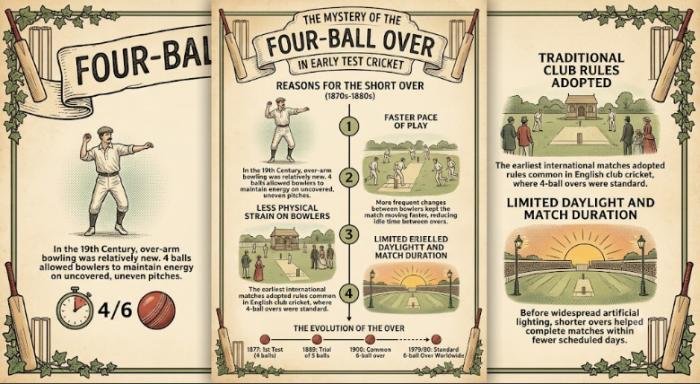
Many readers naturally wonder why the sport began with four-ball overs instead of six. The answer lies in the history of cricket itself. Cricket developed gradually over hundreds of years rather than being designed all at once. The game’s rules evolved whenever administrators believed improvements were necessary. Several reasons influenced the use of four-ball overs.
1. Cricket Was Still Evolving
During the nineteenth century, cricket laws were far from standardized. Different regions often followed slightly different playing conditions, and the game continued adapting as its popularity grew. The four-ball over was simply the accepted practice under the Laws of Cricket at that time.
2. Match Conditions Were Very Different
Cricket in the late 1800s differed greatly from modern cricket. Players competed on uncovered pitches that were heavily influenced by weather conditions. Grounds were less professionally maintained, protective equipment was minimal, and travel between countries was slow.
Shorter overs allowed bowlers to maintain higher intensity despite these demanding conditions.
3. Administrative Simplicity
The Marylebone Cricket Club (MCC), responsible for maintaining the Laws of Cricket, aimed to create practical rules that suited the game’s early structure. Four-ball overs simplified scoring and made it easier for umpires to manage matches. Although this system worked well initially, cricket’s rapid expansion soon exposed its limitations.
The First Official Test Match: A Historic Beginning
Cricket over history, we need to revisit cricket’s most historic match. The first officially recognized Test match took place between Australia and England from 15–19 March 1877 at the Melbourne Cricket Ground.
Australia won by 45 runs, creating one of the sport’s greatest milestones. Several features of this match would seem unusual today.
- Overs contained four legal balls.
- Protective equipment was limited.
- Bat designs differed significantly.
- Fielding techniques were still developing.
- Match tactics were much simpler than modern cricket.
How Cricket Overs Began to Change
As cricket spread across the British Empire, national cricket boards gained greater influence over domestic playing conditions. Rather than following one universal standard, different countries experimented with different over lengths.
This led to one of the most unusual periods in cricket history. Instead of everyone using four-ball overs, nations gradually introduced their own systems. Some preferred:
- Five-ball overs
- Six-ball overs
- Eight-ball overs
For several decades, international cricket existed without a single global standard. This meant players sometimes had to adjust their strategies depending on where they were playing. From a modern perspective, it seems strange that such an important rule could vary between countries. Yet at the time, it reflected cricket’s decentralized administration.
The Introduction of Five-Ball Overs
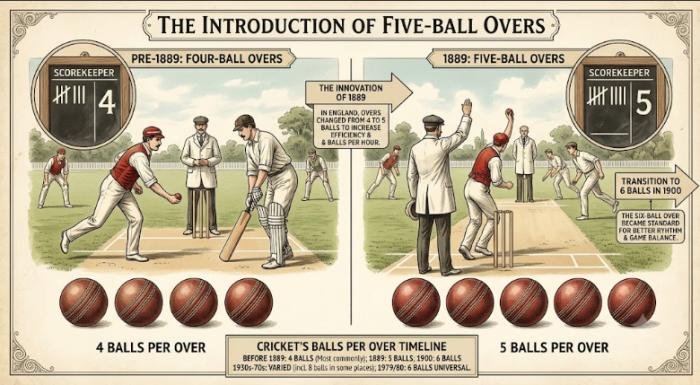
Although four-ball overs dominated early Test cricket, administrators soon began searching for improvements. One experiment involved increasing the over length to five balls. The goal was straightforward.
Officials hoped to reduce the number of interruptions caused by frequent changes of ends while allowing bowlers to settle into a better rhythm. Five-ball overs also reduced the time spent changing field positions and switching bowlers’ directions. However, the format never gained widespread acceptance.
Only a limited number of competitions adopted it, and many administrators believed either four or six balls provided a better balance. As a result, five-ball overs became a relatively short-lived chapter in cricket history. Even so, they played an important role in shaping later decisions about over lengths.
The Rise of Six-Ball Overs
As cricket became more organized during the late nineteenth and early twentieth centuries, many cricket boards concluded that six balls struck the ideal balance between bat and ball. Six-ball overs offered several clear advantages.
First, bowlers had enough deliveries to build pressure on batters without becoming overly fatigued. Second, captains could develop more sophisticated fielding plans over a longer sequence of deliveries. Third, spectators enjoyed a smoother rhythm because the game experienced fewer interruptions.
England became one of the strongest supporters of six-ball overs, and many other cricket-playing nations gradually followed its example. However, not every country agreed. Some believed that even longer overs would improve the game further. That belief eventually led to one of cricket’s most unusual experiments—the eight-ball over, which would become an important chapter in the sport’s evolution.
Evolution of Test Cricket Over Lengths
| Time Period | Balls Per Over | Countries/Regions | Reason or Significance |
| 1877 (First Test Match) | 4 | Australia | The first official Test match between Australia and England was played with four-ball overs under the Laws of Cricket at the time. |
| Late 1800s | 5 | Selected domestic competitions | Some cricket authorities experimented with five-ball overs to improve match flow, but the format was never widely adopted. |
| Early 1900s | 6 | England and several other cricket nations | Six-ball overs became increasingly popular because they offered a better balance between bowlers and batters. |
| Mid-1900s | 8 | Australia, New Zealand, South Africa | Eight-ball overs were introduced to reduce interruptions and allow bowlers to build longer spells, though they increased workload. |
| 1979–80 | 6 | All ICC member nations | The ICC standardized six-ball overs for all international Test matches, creating consistency across world cricket. |
| Present Day | 6 | Worldwide | Every international Test, ODI, and T20 match uses six legal balls per over, making it the global standard. |
The Era of Eight-Ball Overs: Cricket’s Boldest Experiment
While many countries gradually embraced six-ball overs, Australia, New Zealand, and South Africa believed an even longer over could improve the flow of the game. As a result, these nations introduced eight-ball overs in their domestic and Test matches during different periods of the twentieth century.
At first glance, adding two extra deliveries to every over might not seem like a significant change. However, it had a major impact on how Test cricket was played.
For bowlers, an eight-ball over meant more opportunities to pressure a batter without interruption. Skilled fast bowlers could maintain attacking lines and lengths for longer, increasing the chances of taking wickets. Spinners also benefited because they had extra deliveries to set up batters with variations in flight, spin, and pace.
Captains appreciated longer overs because they could keep aggressive field placements in place for a greater number of deliveries. Instead of resetting tactics after six balls, they could continue executing a plan over eight deliveries.
Why Did Different Countries Use Different Over Lengths?
Unlike today’s internationally regulated game, early cricket allowed national boards considerable freedom in setting playing conditions. Several factors influenced these decisions.
Local Cricket Traditions: Each country developed its own cricket culture. Administrators often preferred rules that suited their domestic competitions rather than following overseas practices.
Match Duration: Longer overs reduced the number of changes of ends during a day’s play. This saved time and allowed matches to progress more smoothly.
Bowling Strategy: Some administrators believed longer overs helped bowlers build sustained pressure, while others argued shorter overs kept bowlers fresher and made contests fairer.
Practical Considerations: Travel, weather, pitch conditions, and scheduling varied greatly between countries. Cricket boards often adapted rules to suit local conditions rather than international consistency.
When Did Six-Ball Overs Become the Worldwide Standard?
Although six-ball overs had already become common in several countries, they did not become universal until the late 1970s. During the 1979–80 international season, the International Cricket Council (ICC) officially standardized six legal deliveries per over for all Test matches.
This decision ended decades of inconsistency. From that point onward, every Test-playing nation followed the same over length regardless of where a match was played. The change may seem simple today, but it transformed international cricket in several important ways.
- Statistics became easier to compare across different eras.
- Players no longer needed to adjust to different over lengths when touring overseas.
- Umpiring became more consistent.
- Television broadcasters benefited from predictable match rhythms.
- Fans around the world enjoyed a uniform viewing experience.
Professional Comparison of Over Lengths
| Over Length | Countries That Used It | Advantages | Disadvantages |
| 4 Balls | Australia (early Test cricket) | Frequent bowling changes, reduced fatigue | Too many interruptions, slower overall flow |
| 5 Balls | Limited domestic competitions | Better rhythm than four balls | Never gained widespread popularity |
| 6 Balls | England and eventually worldwide | Balanced workload, consistent strategy, ideal match flow | Few significant drawbacks |
| 8 Balls | Australia, New Zealand, South Africa | Longer pressure on batters, fewer interruptions | Greater bowler fatigue, harder statistical comparisons |
How Changing Over Lengths Affected Match Strategy
Changing the number of balls in an over influenced nearly every aspect of Test cricket.
Bowling Plans
Under four-ball overs, bowlers had limited time to execute tactical plans before changing ends. Six-ball overs gave bowlers enough deliveries to create pressure through consistency. Eight-ball overs allowed bowlers to attack for longer periods but demanded greater physical endurance.
Captaincy Decisions
Captains adjusted field placements according to over length. Longer overs meant fielders remained in attacking positions for extended periods, allowing more elaborate wicket-taking strategies. Shorter overs required more frequent tactical changes.
Batting Approach
Batters also adapted their mindset. Facing four deliveries often encouraged immediate concentration because an over ended quickly. Against eight-ball overs, batters needed greater patience and stamina, knowing they would face longer spells from the same bowler.
Pace of the Game
The rhythm of a cricket match changes depending on over length. Frequent changes of ends create natural pauses in play, while longer overs produce longer uninterrupted passages of cricket. Many historians believe the six-ball over offers the perfect balance between continuous action and strategic variation.
Interesting Facts About Test Cricket Overs
The history of cricket overs contains several fascinating facts that even dedicated fans may not know.
- The first official Test match in 1877 used four-ball overs.
- Five-ball overs were experimented with but never became widely accepted.
- Australia, New Zealand, and South Africa all used eight-ball overs in Test cricket.
- Different over lengths existed simultaneously in international cricket for many decades.
- The ICC standardized six-ball overs worldwide only in 1979–80.
- Modern cricket statistics are much easier to compare because every country now follows the same over length.
- The six-ball over is now used in Test matches, One Day Internationals, T20 Internationals, and most professional domestic competitions.
Common Myths About How Many Balls Were Originally There in One Test Over?
- Myth 1: Test Cricket Has Always Used Six-Ball Overs: This is incorrect. The earliest Test matches featured four-ball overs, while later decades saw five-ball and eight-ball experiments before six balls became the global standard.
- Myth 2: Eight-Ball Overs Were Never Used in International Cricket: False. Several Test matches in Australia, New Zealand, and South Africa were played using eight-ball overs. These matches remain part of official cricket history.
- Myth 3: The ICC Created Cricket’s Original Rules: Another common misunderstanding. The earliest Laws of Cricket were developed long before the ICC existed. The Marylebone Cricket Club (MCC) was responsible for maintaining the Laws of Cricket for many years, while the ICC later took on the role of governing international cricket and ensuring consistent playing conditions.
Conclusion
Cricket’s rich history is filled with fascinating rule changes, and the evolution of the over is one of its most interesting stories. While today’s fans naturally associate an over with six legal deliveries, the earliest days of Test cricket were very different.
The answer to Cricket over history is four balls, but that was only the beginning of a long journey. Experiments with five-ball and eight-ball overs reflected cricket’s search for the ideal balance between bowlers and batters. Eventually, the six-ball over emerged as the most practical and universally accepted format.
Today, every Test match follows this standard, allowing teams from around the world to compete on equal terms. Understanding this history not only answers a popular cricket question but also highlights how the sport has evolved through thoughtful innovation while preserving the traditions that make Test cricket unique.
Whether you’re a lifelong cricket enthusiast or a new fan exploring the game’s origins, knowing the story behind the over adds another layer of appreciation for the world’s oldest and most respected format of cricket.
FAQs
Q1: How many balls were originally there in one Test over?
Ans: Originally, one Test over consisted of four legal balls. This rule was used during the first official Test match between Australia and England in 1877.
Q2: Why did early Test cricket use four-ball overs?
Ans: Four-ball overs reflected the Laws of Cricket in the late nineteenth century. At the time, cricket administrators believed shorter overs suited playing conditions and the structure of the game.
Q3: Did every country use the same number of balls per over?
Ans: No. Different countries adopted different over lengths, including four-ball, five-ball, six-ball, and eight-ball overs before international standardization.
Q4: Which countries used eight-ball overs?
Ans: Australia, New Zealand, and South Africa all used eight-ball overs in domestic and Test cricket during different periods of the twentieth century.
Q5: When did six-ball overs become the international standard?
Ans: The International Cricket Council (ICC) standardized six-ball overs for Test cricket during the 1979–80 international season, ending decades of variation.
Q6: Why was the over length changed?
Ans: The changes aimed to improve consistency, reduce interruptions, simplify officiating, create fairer competition, and make international cricket easier to organize and compare statistically.
Q7: Could Test cricket ever return to four-ball or eight-ball overs?
Ans: It is highly unlikely. The six-ball over has become a globally accepted standard and provides the best balance between strategy, workload, entertainment, and fairness.