New York Magazine: History, Journalism and Cultural Impact
New York Magazine is one of the most recognizable names in American magazine journalism. Since its launch as an independent publication in 1968, it has developed from a city-focused magazine into a broader media brand known for reporting, criticism, politics, culture, style, food, entertainment, and urban life.
Its influence comes not only from the stories it publishes but also from the editorial approach it helped popularize. Over the decades, New York Magazine has been associated with distinctive feature writing, New Journalism, memorable visual design, cultural criticism, and an ability to turn local subjects into national conversations.
Today, the publication reaches audiences through its magazine and a network of specialized editorial brands, making its history an important part of the larger story of how American journalism moved from traditional print publishing into a digital, multiplatform environment.
What Is New York Magazine?
New York Magazine is an American general-interest publication with a strong historical connection to New York City. Its journalism and commentary cover subjects including politics, culture, entertainment, fashion, food, media, business, and urban life.Although New York City remains central to its identity, the publication’s scope expanded over time. Many of its stories now address national politics, American culture, media, and broader social trends.
Read More: Samsung Galaxy S26 Ultra: Expected Release Date, Price & Specs
A common source of confusion is the similarity between New York Magazine and The New Yorker. They are separate publications with different histories, editorial organizations, and styles. The New Yorker was founded in 1925, while the modern independent version of New York Magazine began publishing in 1968.The magazine is particularly associated with a direct, contemporary editorial voice and with journalism that combines reporting, criticism, analysis, narrative writing, and service-oriented coverage.
| Quick Fact | Information |
| Publication | New York Magazine |
| Independent launch | 1968 |
| Founders | Clay Felker and Milton Glaser |
| Based in | New York City |
| Main subjects | Politics, culture, style, entertainment, food, media, and city life |
| Notable digital brands | Intelligencer, The Cut, Vulture, The Strategist, Curbed, and Grub Street |
| Editorial approach | Reporting, commentary, criticism, narrative journalism, and service journalism |
The History of New York Magazine
From a Newspaper Supplement to an Independent MagazineThe roots of New York Magazine can be traced to the New York Herald Tribune. Before becoming an independent magazine, New York existed as a Sunday supplement connected to the newspaper.Clay Felker played a major role in developing that earlier publication. When the New York Herald Tribune ceased publication in the 1960s, Felker and designer Milton Glaser helped bring the magazine back as an independent publication.
The first issue of the independent New York Magazine was dated April 8, 1968.This history mattered because the new publication was not simply designed to report routine city news. It aimed to capture the energy, personalities, politics, commerce, culture, and changing social character of New York City.
Clay Felker and Milton Glaser
Clay Felker shaped the magazine’s editorial direction. He supported ambitious writers and encouraged a style of journalism that could be analytical, personal, narrative, and deeply connected to contemporary life.Milton Glaser, one of America’s most influential graphic designers, helped create the publication’s visual identity.
His contribution demonstrated that design could be part of a magazine’s editorial personality rather than simply a decorative element.Together, Felker and Glaser helped establish an identity that combined journalism, design, cultural observation, and a strong sense of place.
Growth Beyond New York City
Although the publication began with a close focus on its namesake city, New York Magazine gradually expanded its reach.New York itself remained an important subject, but the magazine increasingly covered national politics, entertainment, business, media, and cultural debates.
This broader scope allowed stories that originated in New York to become part of national conversations.The result was a publication that retained a strong urban identity while becoming influential far beyond the five boroughs.
New York Magazine and New Journalism
What Is New Journalism?
New Journalism is generally associated with nonfiction writing that uses some techniques commonly found in fiction, including scene-building, dialogue, detailed characterization, and narrative structure.The purpose is not to fictionalize reporting. Instead, the approach attempts to make factual reporting more vivid and immersive while retaining journalistic discipline.New York Magazine became closely associated with this movement during an era when American journalism was experimenting with new forms of feature writing.
A Home for Distinctive Writers
The publication became associated with writers whose work went beyond conventional newspaper reporting. Tom Wolfe, Jimmy Breslin, Nora Ephron, and Pete Hamill are among the prominent writers connected with its history.Their work represented different approaches, but they shared an ability to connect reporting with voice, observation, storytelling, and cultural analysis.This editorial tradition helped demonstrate that magazine journalism could be both informative and stylistically distinctive.
The Editorial Areas of New York Magazine
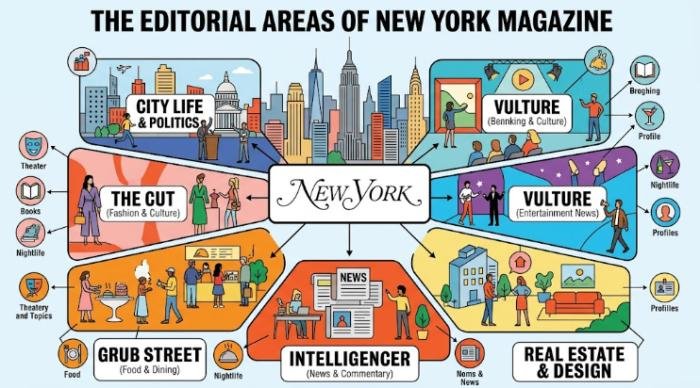
As its audience and digital presence expanded, New York Magazine developed specialized editorial brands that focus on particular subjects.
Intelligencer: Intelligencer covers politics, media, business, technology, and public affairs. Its purpose is to interpret major developments while also following the personalities and institutions that influence public life.The section reflects the publication’s longstanding interest in political reporting and commentary.
The Cut: The Cut focuses on style, identity, culture, fashion, work, relationships, and power.Its editorial approach often connects subjects that might traditionally have been treated separately. Fashion, for example, can also become a story about business, gender, celebrity, culture, or social change.
Vulture: Vulture is the entertainment and culture brand associated with New York Magazine. Its coverage includes television, film, music, books, comedy, celebrity, and criticism.Vulture is particularly known for combining news with criticism and deeper cultural interpretation.
The Strategist: The Strategist focuses on service journalism and product recommendations.Its approach differs from traditional advertising because its editorial content is structured around helping readers identify useful products and understand why particular items may suit specific needs.
Curbed: Curbed covers cities, housing, real estate, architecture, design, and urban life.Its subjects reflect issues that have long been central to New York Magazine, including how people live, how neighborhoods change, and how cities develop.
Grub Street: Grub Street focuses on food, restaurants, dining culture, and the restaurant industry.Food coverage has been an important part of the magazine’s broader cultural identity, especially in a city where restaurants and dining trends often reflect economic and social change.
How New York Magazine Changed From Print to Digital
The media industry changed dramatically with the growth of the internet, smartphones, social media, newsletters, podcasts, and digital subscriptions.For a legacy publication, surviving these changes required more than simply placing print articles online.New York Magazine increasingly developed specialized digital brands with distinct identities and audiences. This structure allowed readers interested primarily in entertainment, politics, fashion, food, cities, or shopping to find focused editorial coverage.
The growth of digital publishing also created opportunities for different formats. A modern media organization can publish breaking news, long-form features, criticism, newsletters, podcasts, video, and commerce-oriented journalism alongside traditional magazine stories.This transformation illustrates a broader change in American media: successful publications increasingly operate as networks of editorial brands rather than as a single print product.
How New York Magazine Influenced American Journalism
A Strong Editorial Voice: One of the publication’s most important contributions has been its belief that journalism can have a recognizable voice without abandoning factual reporting.Articles associated with New York Magazine have often emphasized interpretation, narrative structure, distinctive writing, and cultural context.
Narrative Feature Writing: Magazine journalism provides space for stories that may require more depth than a conventional news report.The publication’s history demonstrates the value of long-form reporting and narrative nonfiction. Writers can investigate an event or subject while also showing readers the people, institutions, conflicts, and environments behind it.
Local Stories With National Relevance: New York City is frequently treated as both a physical location and a cultural symbol. Changes in the city’s politics, real estate, fashion, entertainment, restaurants, and media can eventually influence wider national trends.New York Magazine has benefited from this relationship. A story may begin with a neighborhood, a local political figure, or a cultural event but develop into a broader discussion about American society.
The Cultural Impact of New York Magazine
Documenting a Changing City
The history of New York Magazine is closely connected to the history of New York City itself.The publication has covered changing neighborhoods, political conflicts, economic pressures, restaurants, architecture, fashion, entertainment, and media. Together, these subjects form a long-running record of how urban life changes over time.
Influence on Popular Culture
The magazine and its digital brands have contributed to discussions about television, film, books, comedy, celebrity, music, and other forms of entertainment.Cultural criticism can have a significant influence because it does more than recommend or reject a work. Strong criticism can explain why a film, television program, book, or public figure matters at a particular moment..
Fashion, Food, and Lifestyle Journalism
Fashion and food may appear to be lifestyle subjects, but they can also reveal larger economic and cultural patterns.The Cut examines fashion and style alongside identity and social power. Grub Street approaches restaurants and food as part of city life and culture.This broad interpretation of lifestyle journalism is one reason the New York Magazine ecosystem has remained relevant across changing media environments.
Visual Culture and Magazine Design
The publication’s visual identity has also been important to its cultural influence.Milton Glaser’s involvement from the beginning established design as a central part of the magazine’s character. Magazine covers, typography, photography, illustration, and layout can influence how readers understand a story before reading a single paragraph.For this reason, the visual history of New York Magazine is closely connected to its editorial history.
Challenges Facing New York Magazine

The Decline of Traditional Print Economics
Print advertising and newsstand sales have faced major pressure from digital publishing.
Like many legacy publications, New York Magazine has had to adapt to changing consumer habits. Readers now expect immediate access to articles through phones, computers, newsletters, and social platforms.
Competition for Attention
Modern media organizations compete not only with other magazines and newspapers but also with creators, social platforms, video services, newsletters, podcasts, and algorithm-driven feeds.This competition makes editorial identity increasingly important. A publication needs readers to understand what makes its coverage different.
Maintaining a Historic Identity
One challenge for a publication with decades of history is balancing tradition and innovation.New York Magazine must preserve the qualities that made its journalism distinctive while adapting to new formats, audiences, and technology.
Why New York Magazine Still Matters
The continuing relevance of New York Magazine comes from its ability to operate across multiple areas of journalism.It can publish political analysis through Intelligencer, cultural criticism through Vulture, fashion and society journalism through The Cut, urban coverage through Curbed, food reporting through Grub Street, and service journalism through The Strategist.
This structure gives the larger publication a wide range while allowing individual brands to develop specialized expertise.Its historical importance is equally significant. From its association with New Journalism to its influential writers and visual identity, the publication represents an important chapter in the development of American magazine journalism.
New York Magazine vs. The New Yorker and Other Major Magazines
Although New York Magazine is sometimes confused with The New Yorker, the two publications have different histories and editorial traditions.The New Yorker is generally associated with literary journalism, fiction, criticism, essays, and deeply reported long-form writing. New York Magazine has historically maintained a more immediate connection to city life, contemporary culture, politics, service journalism, and rapidly changing social trends.
Compared with publications such as The Atlantic or Vanity Fair, New York Magazine also has its own combination of local identity and national cultural influence.The differences between these publications should not be reduced to a simple question of quality. Each has a distinct editorial mission, audience, style, and historical development.
Conclusion
New York Magazine has evolved significantly since its independent launch in 1968, but its central strengths have remained recognizable: a strong editorial voice, attention to contemporary life, ambitious journalism, cultural criticism, and a close connection to the changing character of New York City.
Its story also reflects the transformation of American media. What began as a city-focused magazine grew into a nationally influential publication and later became part of a larger digital media network. Along the way, it helped elevate narrative journalism, introduced readers to influential writers, and developed editorial brands that now serve specialized audiences.
For readers interested in American journalism, media history, cultural criticism, or the evolution of New York City, New York Magazine remains an important publication to understand. Its legacy is not limited to a single magazine format. Instead, it lies in the continuing relationship between strong reporting, distinctive storytelling, visual identity, and the cultural conversations that journalism can help shape.
Frequently Asked Questions About New York Magazine
Q1. What is New York Magazine known for?
Ans: New York Magazine is known for journalism and commentary covering politics, culture, entertainment, fashion, food, media, and city life. It is also historically associated with New Journalism and distinctive narrative feature writing.
Q2. When was New York Magazine founded?
Ans: The independent version of New York Magazine was launched in 1968. Its first issue was dated April 8, 1968, although its origins can be traced to an earlier Sunday supplement of the New York Herald Tribune.
Q3. Who founded New York Magazine?
Ans: Clay Felker and Milton Glaser founded the independent magazine. Felker shaped its editorial vision, while Glaser played a major role in its design and visual identity.
Q4. Is New York Magazine the same as The New Yorker?
Ans: No. New York Magazine and The New Yorker are separate publications with different histories, editorial organizations, and styles.
Q5. What does New York Magazine cover?
Ans: Its coverage includes politics, media, entertainment, culture, fashion, food, cities, design, consumer topics, and broader social issues through the magazine and its specialized editorial brands.
Q6. What are the major New York Magazine digital brands?
Ans: Major brands associated with the New York Magazine ecosystem include Intelligencer, The Cut, Vulture, The Strategist, Curbed, and Grub Street.
Q7. How did New York Magazine influence journalism?
Ans: The publication became closely associated with New Journalism and helped demonstrate the potential of narrative nonfiction, distinctive authorial voices, cultural criticism, and deeply reported magazine features.